
As Malaysia advances toward full implementation of mandatory e-Invoicing, businesses are discovering that compliance isn’t just a matter of ticking boxes—it requires rethinking how invoices are generated, sent, and integrated across multiple systems. For many, omnichannel gaps are becoming a key challenge.
Whether you’re running a retail outlet with a POS system, selling online via marketplaces, or offering services with manual invoicing, inconsistent systems can make e-Invoicing compliance a nightmare. Fortunately, cloud accounting solutions are proving to be the missing link that bridges these gaps.
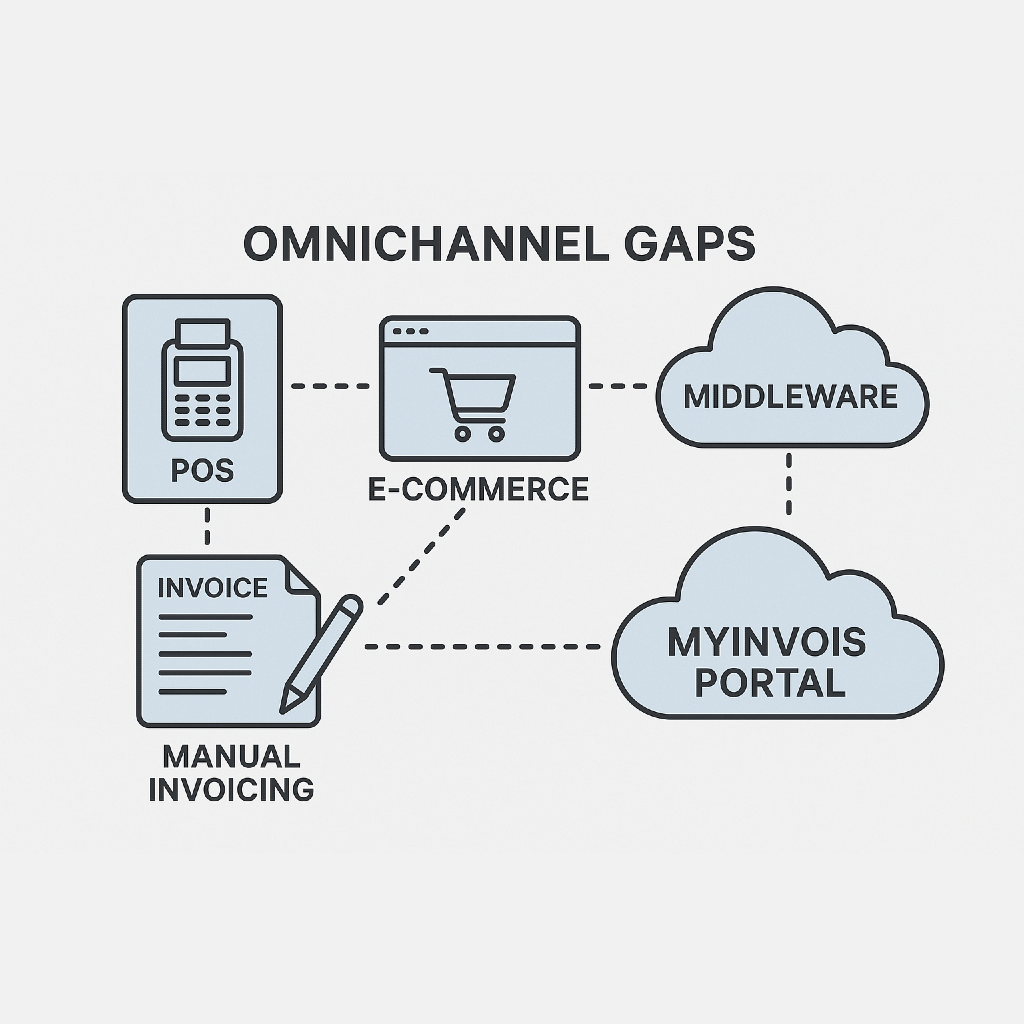
What Are Omnichannel Gaps?
Omnichannel gaps refer to the disconnects between various systems and sales channels in a business—especially when it comes to issuing and managing invoices.
In Malaysia’s context, here’s how these gaps typically appear:
- A business uses one software for accounting, another for sales, and a separate system for inventory.
- Sales happen across multiple platforms—retail POS, e-commerce websites, social media—but the invoicing isn’t centralised.
- Manual processes are needed to copy information between systems to meet LHDN’s MyInvois e-Invoicing requirements.
- Some systems can’t communicate with the MyInvois API at all, requiring manual uploads.
The result? Duplicated efforts, costly errors, and a risk of non-compliance as Malaysia’s tax system becomes fully digital.
Why Omnichannel Gaps Are a Problem for e-Invoicing
Malaysia’s phased implementation of e-Invoicing (starting with large businesses and expanding to all by July 2026) means that every invoice must:
- Be submitted to LHDN’s MyInvois platform,
- Include required fields and formats,
- Be validated in real-time before it’s shared with customers.
If your systems aren’t integrated, you may face:
- Delays in invoice approval and delivery,
- Incomplete or invalid data submissions,
- Increased manual workload and human error,
- Poor customer experience and slower payments.
What About On-Premise Accounting + Middleware?
Some businesses in Malaysia rely on on-premise accounting software paired with middleware to comply with e-Invoicing. While this setup can achieve compliance, it introduces more layers and more potential for omnichannel gaps:
- You need to interact with multiple components: the on-premise system, the middleware tool, and the MyInvois portal.
- Middleware often requires manual triggering of invoice submissions, increasing the chance of oversight.
- Sales channels like POS systems or online platforms may not be directly connected to your accounting system, leading to manual entry or batch uploads.
- Any issue in one layer (e.g., middleware errors or version mismatches) can disrupt the entire process.
This kind of fragmented flow makes it harder to maintain real-time compliance and smooth operations—especially for small to mid-sized businesses without in-house IT support.
In Contrast: Cloud Solutions Are Self-Contained
Modern cloud accounting platforms like Bukku are already integrated directly with LHDN’s MyInvois system, offering an all-in-one approach:
- Invoice generation, validation, and submission happen seamlessly in one place.
- Real-time feedback from LHDN (e.g., invoice status, QR code, IRN) is immediately available.
- Sales data from POS or e-commerce can be synced directly through native integrations or plugins.
- No middleware. No manual batch uploads. No switching between systems.
This reduces complexity, improves compliance, and lets your team focus on growing the business rather than managing systems.
How Adventus Can Help
At Adventus, we help Malaysian businesses make sense of the e-Invoicing landscape by:
- Advising on the best-fit cloud solution based on your business size, reporting needs, and operations.
- Setting up and configuring the chosen solution to ensure your sales, billing, and finance processes are e-Invoicing-ready.
- Training your team to use the system effectively and ensure everyone understands how e-Invoices flow to the MyInvois portal.
- Ensuring your different sales channels (e.g., retail, online, services) work in harmony with the selected cloud platform, avoiding fragmented workflows or compliance risks.
Xero, QuickBooks Online, and Bukku already support e-Invoicing integration with LHDN’s MyInvois portal—we help ensure your business is ready to make the most of that built-in capability.
Conclusion
The move to e-Invoicing in Malaysia is more than a tax change—it’s a digital transformation. Businesses that embrace cloud solutions can close omnichannel gaps, reduce compliance headaches, and operate more efficiently across all customer touchpoints.
If your invoicing process feels disconnected or difficult to manage across platforms, it’s time to consider a cloud-first approach—and Adventus is here to guide you.