
Is Your e-Invoice Solution Helping Your Business, Or Slowing It Down?
Malaysia’s e-Invoice mandate is supposed to modernise business processes, improve compliance, and reduce manual work.
But for many businesses, the reality has been very different.
Instead of saving time, some e-Invoice solutions are introducing more complexity, more manual checking, more downtime, and more frustration into daily operations.
If you are currently using an e-Invoice solution, ask yourself these questions.
Does Your System Clearly Show If Customer Information Is Complete?
Before issuing an e-Invoice, businesses must ensure that customer information is accurate and complete.
But does your system actually help you do that?
- Does it provide clear visual indicators when mandatory fields are missing?
- Can users instantly see whether the customer record is ready for e-Invoice submission?
- Or are staff expected to manually remember which fields are required?
A missing Tax Identification Number (TIN), SST number, address detail, or incorrect identification type can result in rejected invoices and unnecessary delays.
A good system should proactively help users avoid mistakes, not leave them guessing.
Can Users Still Submit Invoices Even When Information Is Incomplete?
One of the biggest frustrations businesses face is discovering submission errors only after the invoice has already been sent for validation.
Ask yourself:
- Does your system stop users from submitting incomplete or invalid invoices?
- Does it validate the information before submission?
- Does it explain clearly what is wrong?
Or does it simply allow the submission to fail later?
When systems do not enforce proper validation upfront, businesses waste time correcting avoidable errors after the fact.
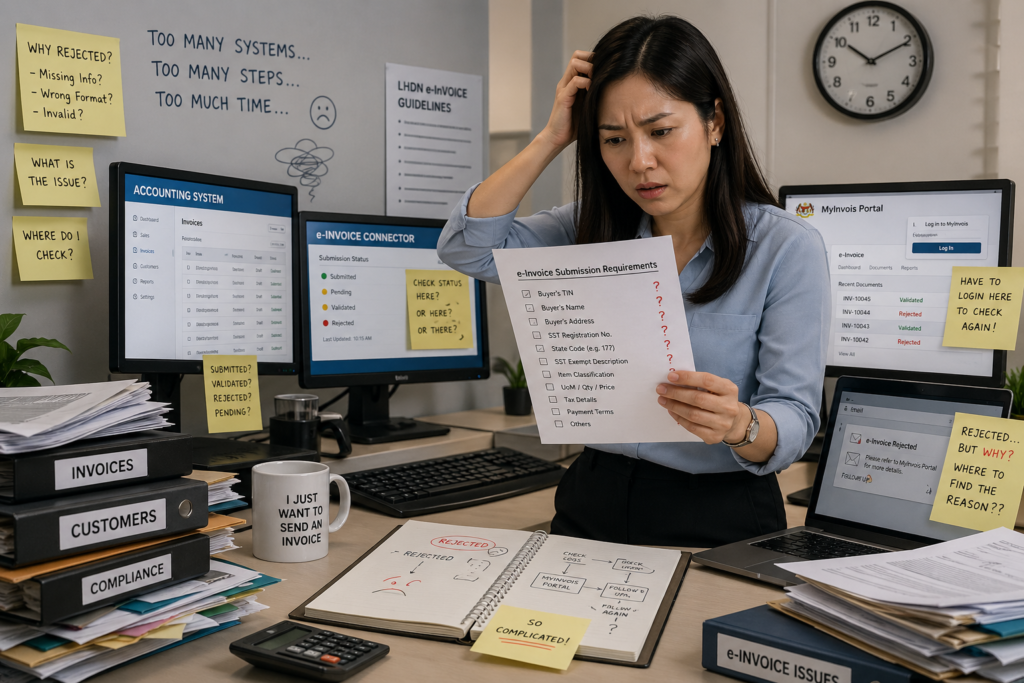
Do You Need Multiple Systems Just to Check Invoice Status?
This is a surprisingly common issue.
Many businesses must constantly switch between:
- Their accounting system
- Middleware or connector software
- Email notifications
- The MyInvois Portal
just to determine:
- Was the invoice submitted?
- Was it validated?
- Was it rejected?
- Is it still pending?

This fragmented workflow creates confusion and increases the risk of missed or delayed follow-ups.
An efficient solution should provide everything in one place.
If an Invoice Is Rejected, Is Finding the Problem a Nightmare?
When an invoice is rejected, businesses need answers quickly.
But in many systems:
- Error messages are technical and difficult to understand
- Users must search through logs or external portals
- Staff need to contact support just to interpret the issue
- Multiple systems need to be checked to identify the root cause
This turns what should be a simple correction into a time-consuming support exercise.
Your accounting team should not need to become IT troubleshooters just to issue invoices.
Are You Still Printing PDFs and Manually Emailing Customers?
Despite “digital transformation,” some workflows are still heavily manual.
Ask yourself:
- Does your staff still print invoices to PDF?
- Are they manually attaching invoices to emails?
- Are they manually checking whether the validated e-Invoice version was attached?
These tasks may seem small individually, but over hundreds or thousands of invoices, they consume significant time.
Modern cloud-based solutions should automate these processes seamlessly.
Are Error Messages Clear — Or Completely Cryptic?
Many businesses encounter vague or technical errors such as:
- Invalid classification code
- Unsupported document type
- Incorrect state code
- Validation schema mismatch
But what does that actually mean to the average user?
A user-friendly system should:
- Explain errors in plain language
- Tell users exactly what needs to be corrected
- Provide guidance immediately within the workflow
Technology should reduce confusion, not create more of it.
Have You Experienced Downtime During Critical Billing Periods?
This is one of the biggest operational risks with some on-premise systems.
Businesses have reported situations where they:
- Could not issue invoices
- Had to wait for patches or updates
- Encountered bugs after new LHDN requirements were introduced
- Faced compatibility issues after system upgrades
Recent examples include changes involving:
- SST exempt description requirements
- Restrictions involving State Code 17 for consolidated invoices
- Validation rule changes from LHDN
When compliance requirements evolve, businesses need systems that adapt quickly, without disrupting operations.
Do You Need to Uninstall and Reinstall Software for Updates?
Some businesses still go through upgrade processes that involve:
- Uninstalling existing software
- Installing a new version manually
- Upgrading database files
- Ensuring compatibility between versions
- Coordinating downtime with users
This creates operational disruption and unnecessary dependency on technical support.
In today’s environment, updates should happen seamlessly in the background.
Other Common Frustrations Businesses Face
Many businesses also encounter issues such as:
Heavy Dependence on IT Support
Simple operational tasks suddenly require technical intervention.
Even small configuration changes may require vendor assistance.
Limited Remote Access
On-premise systems often make remote work difficult or complicated, especially for businesses with multiple branches or hybrid teams.
Slow Adaptation to Regulatory Changes
LHDN requirements continue to evolve.
Businesses need solutions that can respond quickly without waiting weeks or months for updates.
High Hidden Costs
The software licence may not be the only cost.
Businesses often also pay for:
- Server maintenance
- Backup systems
- Upgrade fees
- Technical support
- Database maintenance
- Remote access infrastructure
- Downtime-related productivity losses
The “cheaper” solution may not actually be cheaper in the long run.
Time Lost Adds Up Quickly
Now consider how much time your team spends on:
- Correcting rejected invoices
- Checking multiple systems
- Following up on validation statuses
- Troubleshooting issues
- Performing upgrades
- Contacting support
- Re-sending invoices
- Managing manual workflows
How many hours are lost every month?
How much productivity is being sacrificed just to stay compliant?
There Is a Better Way
e-Invoicing should simplify your operations, not complicate them.
A modern e-Invoice solution should:
- Guide users clearly
- Prevent errors before submission
- Automate repetitive tasks
- Centralise invoice tracking
- Provide user-friendly error messages
- Adapt quickly to LHDN changes
- Eliminate disruptive upgrades and downtime
- Empower users instead of frustrating them
Most importantly, it should allow your business to focus on serving customers, not fighting with software.
And the best part?
A better, more user-friendly solution does not necessarily cost more than traditional on-premise systems.
In many cases, it may actually cost less once you factor in the hidden operational costs, downtime, maintenance, and lost productivity.
The question is no longer whether your business needs an e-Invoice solution.
The real question is:
Is your current e-Invoice solution truly helping your business move forward?
Ready for a Simpler, Smarter e-Invoice Experience?
At Adventus Business Consult, we believe e-Invoicing should make your business operations easier, not more complicated.
As a value-added partner for leading cloud-based accounting and e-Invoice solutions, we help Malaysian businesses implement systems that:
- Reduce manual work
- Minimise validation errors
- Simplify compliance with LHDN requirements
- Automate invoice workflows
- Eliminate disruptive upgrades and downtime
- Provide easier access to information from anywhere
- Adapt more quickly to changing regulations
Most importantly, we focus on recommending and supporting practical, user-friendly solutions designed for real business users, not just IT teams.
If you are frustrated with complicated workflows, cryptic errors, multiple systems, or constant maintenance issues, it may be time to explore a better approach.
Contact Adventus Business Consult today to discover how a modern cloud-based e-Invoice solution can simplify compliance, improve productivity, and reduce operational headaches, without costing more than traditional on-premise systems.