
For small businesses in Malaysia, every Ringgit counts. Choosing the right tools to manage accounting, payroll, invoicing, and daily operations can mean the difference between growth and unnecessary overheads. Traditionally, many SMEs have relied on desktop software installed on office computers. However, with the rise of digital transformation and new compliance requirements (such as LHDN’s e-Invoicing), cloud solutions are proving to be a smarter, more sustainable choice.
Below, we’ll look at why cloud solutions are better for small businesses, followed by a cost comparison with desktop applications.
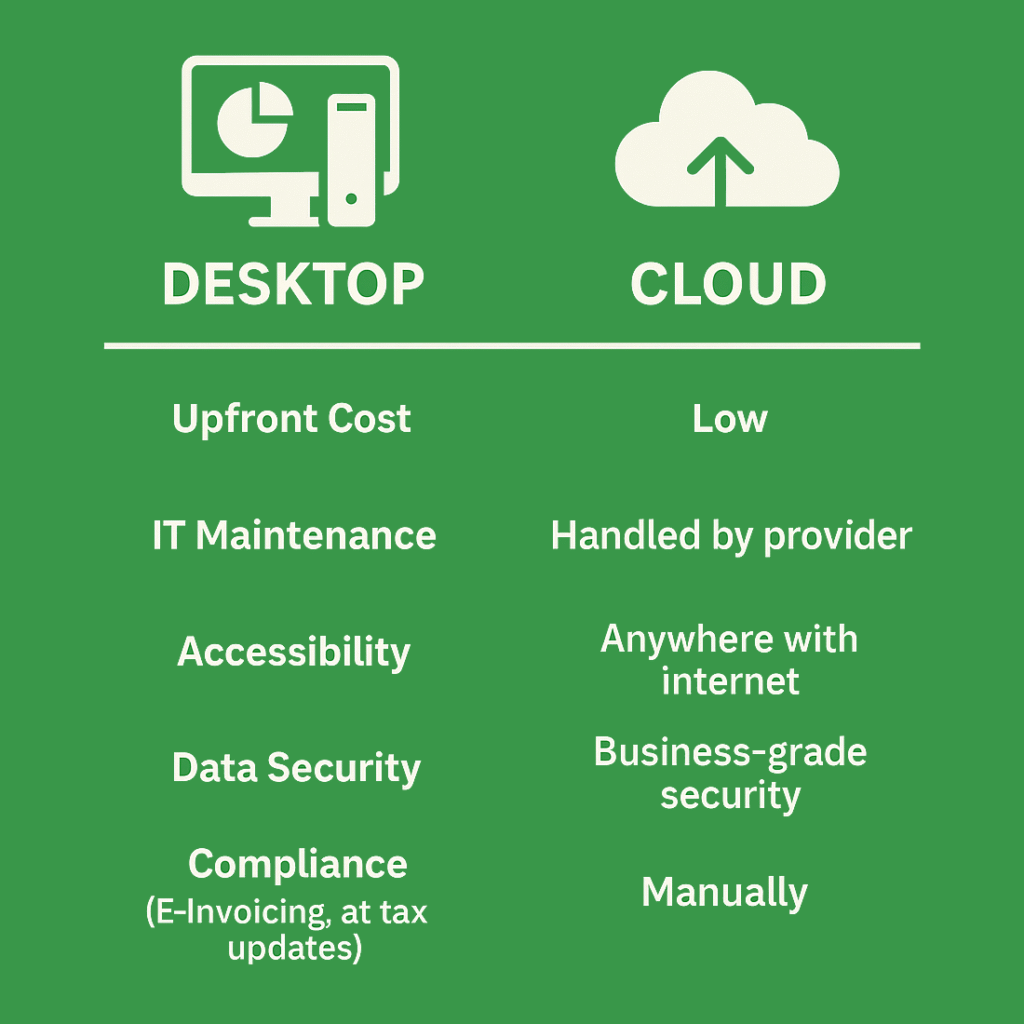
Why Cloud Solutions Make Sense for Small Businesses
1. Lower Upfront Costs
Desktop applications usually require a large one-time purchase or yearly license renewals, plus the cost of hardware upgrades to run them. Cloud solutions, on the other hand, operate on a subscription model—monthly or yearly—making costs predictable and easier to manage.
2. No IT Maintenance Headaches
With desktop software, you’re responsible for installations, updates, and backups. This often means hiring IT support or dedicating staff time. Cloud solutions handle all updates and backups automatically in the background.
3. Work From Anywhere
Whether you’re in Kuala Lumpur, Penang, or even overseas, cloud solutions allow you to log in securely and manage your business anytime, anywhere—something desktop software simply cannot match.
4. Data Security
Cloud providers invest heavily in security, encryption, and compliance. By comparison, if a desktop computer crashes or gets infected with malware, your business data could be lost unless you have expensive backup systems in place.
5. Built-in Compliance for Malaysia
With LHDN’s e-Invoicing rules, EPF, SOCSO, and SST requirements, cloud-based accounting and payroll systems are already adapting to ensure compliance. Desktop systems often require manual patches, add-ons, or workarounds.
Cost Comparison: Desktop Applications vs Cloud Solutions
Cost Item | Desktop Applications | Cloud Solutions |
|---|---|---|
Software License | RM1,500 – RM3,500 (one-time, but upgrades often needed every 2–3 years) | RM50 – RM120 per month (per business, unlimited users in some plans) |
Annual Renewal/Upgrades | RM800 – RM1,200 per year | Included in subscription |
Server / Hardware Costs | RM3,000 – RM5,000 every 3–4 years (plus UPS, backup drives) | None required |
Backup Solutions | RM500 – RM1,000 per year (external drive or cloud backup) | Included |
IT Support/Maintenance | RM1,200 – RM3,000 per year (for updates, troubleshooting, reinstallation) | Minimal (provider handles updates) |
Accessibility | Office PC only (extra cost for remote access setup) | Anywhere with internet, included |
Compliance Updates (e-Invoicing, tax, etc.) | Additional upgrade fees/manual patches | Automatic updates included |
Estimated 3-Year Cost
- Desktop Applications (5 users)
RM1,500 license + RM3,000 hardware + RM1,000/year upgrades + RM2,000/year IT = ~RM12,500 over 3 years - Cloud Solutions (5 users)
RM100/month × 36 months = ~RM3,600 over 3 years (with everything included)
That’s nearly 70% cost savings with cloud solutions, not counting the time saved on updates and IT issues.
The Bottom Line for Small Businesses
Small businesses in Malaysia no longer need to worry about large upfront costs, software crashes, or missing compliance deadlines. Cloud solutions offer affordability, flexibility, and peace of mind—all essential for growth in today’s fast-changing business environment.
If your business is still relying on desktop software, now is the best time to make the switch. With e-Invoicing becoming mandatory, cloud solutions don’t just save money—they keep your business future-ready.