Is Your Invoice Legally Enforceable?
Essential Details Every Malaysian Business Invoice Should Include
Many small business owners assume that once they issue an invoice, they automatically have a legally enforceable claim against their customer.
Unfortunately, debt recovery is rarely that simple.
When a customer disputes a debt or refuses to pay, the quality of your documentation can determine whether you successfully recover the amount owed. An invoice is an important piece of evidence, but it is only one part of the overall documentation trail.
To strengthen your position and improve your chances of recovering unpaid debts, every business should ensure its invoices contain the necessary details and are supported by proper records.
Why Invoice Details Matter
An invoice serves several purposes:
- Records the sale of goods or services
- Communicates payment obligations
- Supports accounting and tax compliance
- Provides evidence in the event of a payment dispute
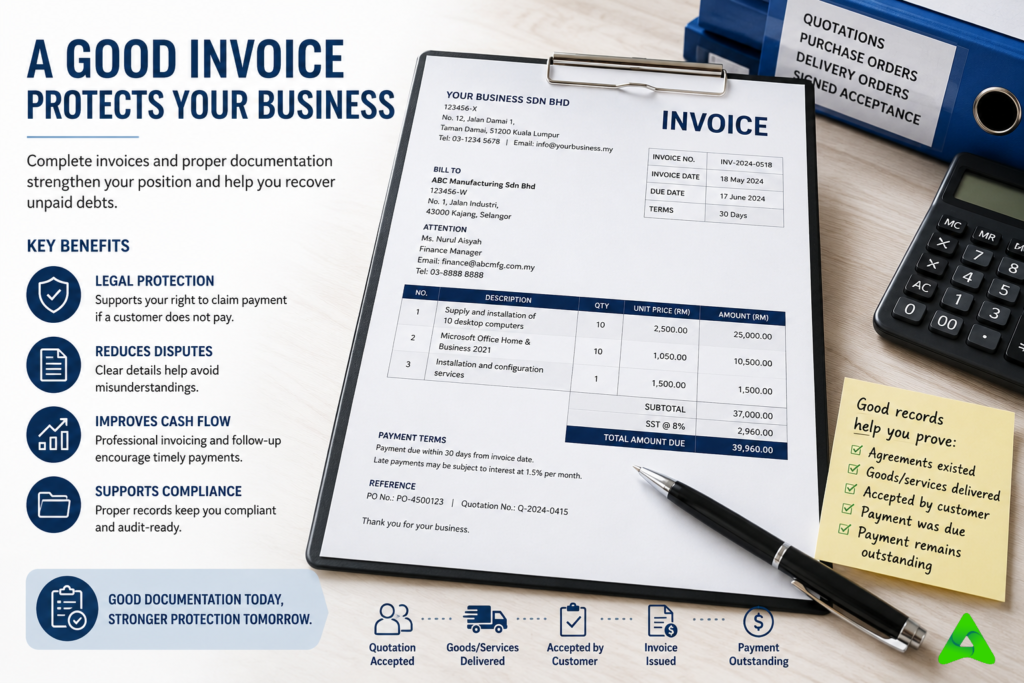
If legal action becomes necessary, the court will typically look for evidence that:
- A contract or agreement existed.
- Goods or services were delivered.
- The customer accepted the goods or services.
- Payment was due.
- Payment remains outstanding.
A properly prepared invoice helps establish these facts.
Essential Information Every Invoice Should Include
1. Supplier’s Full Business Details
Include:
- Business name
- Business registration number
- Registered address
- Contact details
For companies, use the registered company name as recorded with the Companies Commission of Malaysia (SSM).
2. Customer’s Full Details
The invoice should clearly identify the customer that is legally responsible for payment.
Minimum details to include:
- Customer name (individual or company)
- Company registration number (for businesses)
- Registered or business address
Avoid issuing invoices to generic names such as “Accounts Department”, “Finance Team”, or “Management”. The legal entity responsible for payment should be clearly identified.
Additional details recommended for debt recovery and follow-up:
- Contact person’s name
- Department (e.g., Finance Manager, Accounts Executive)
- Telephone number
- Email address
These additional details are not usually required to establish who owes the debt, but they can be extremely valuable when:
- Following up on overdue invoices
- Resolving billing disputes
- Confirming receipt of invoices
- Escalating collection efforts
- Demonstrating that invoices and reminders were sent to the appropriate person
For example:
Customer: ABC Manufacturing Sdn Bhd
Registration No: 123456-X
Address: 1, Jalan Industri, 43000 Kajang, Selangor
Attention: Ms Nurul Aisyah, Finance Manager
Email: finance@abcmfg.com.my
Tel: 03-8888 8888
An Even Better Practice
Where possible, obtain and retain:
- The name of the person who approved the quotation or purchase order.
- The name of the person who accepted delivery of goods or services.
- The name of the finance contact responsible for processing payment.
When a debt dispute arises, being able to demonstrate that specific individuals within the customer’s organisation requested, approved, received, or acknowledged the goods or services can significantly strengthen your position.
For larger transactions, keeping records of these individuals in your accounting system, or supporting documents, may be just as important as the invoice itself. A court will typically look at the entire chain of evidence, not just the invoice, to determine whether the debt is valid and payable.
3. Unique Invoice Number
Every invoice should have a unique reference number.
This helps:
- Track payments
- Avoid duplicate invoices
- Demonstrate proper record keeping
- Support tax compliance
4. Invoice Date
The invoice date establishes:
- When payment became due
- The age of the debt
- The start of any agreed credit period
5. Clear Description of Goods or Services
One of the most common causes of disputes is vague descriptions.
Avoid descriptions such as:
- “Consultancy Services”
- “Work Done”
- “Professional Fees”
Instead, be specific:
- “Payroll processing services for April 2026”
- “Supply and installation of 10 desktop computers”
- “Website development services as per quotation Q-2026-015”
Detailed descriptions make it harder for customers to dispute what was supplied.
6. Quantity, Unit Price and Total Amount
The invoice should clearly show:
- Quantity supplied
- Unit price
- Discounts (if any)
- Applicable taxes
- Total amount payable
This creates transparency and reduces disputes.
7. Payment Terms
Always specify:
- Payment due date
- Credit period (e.g., 30 days)
- Accepted payment methods
For example:
“Payment due within 30 days from invoice date.”
Without clear payment terms, disagreements may arise regarding when payment was expected.
8. Late Payment Terms
Where applicable, state:
- Late payment interest
- Administrative charges
- Collection costs
For example:
“Late payments may be subject to interest at 1.5% per month.”
However, such charges are easier to enforce when they have been agreed to in advance through quotations, contracts, or terms and conditions.
9. Reference to Quotation, Purchase Order or Contract
Where possible, include references such as:
- Quotation number
- Purchase order number
- Contract reference number
This helps link the invoice to the original agreement.
Example:
“Services provided pursuant to Quotation Q-2026-015 accepted on 15 May 2026.”
10. e-Invoice Compliance Information
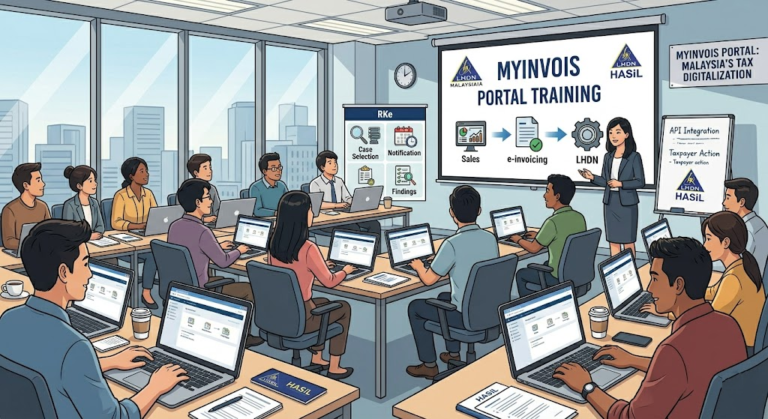
Where applicable, businesses should ensure their invoices comply with Malaysia’s e-Invoicing requirements issued by the Inland Revenue Board of Malaysia (LHDN).
While tax compliance and debt recovery are separate matters, maintaining compliant records strengthens overall documentation and credibility.
11. Invoice Dispute Notification Period
Businesses should consider including a clause requiring customers to report any invoice discrepancies within a specified period, such as seven (7) days from receipt.
This helps:
- Identify billing errors promptly.
- Reduce disputes raised long after the invoice was issued.
- Establish a clear process for resolving concerns.
- Strengthen the supplier’s position if payment is later disputed.
A typical clause may state that if no written objection is received within seven (7) days, the invoice will be deemed accepted and payable according to the stated payment terms.
Example:
Please review this invoice upon receipt. Any discrepancy, dispute, or objection relating to this invoice must be notified to us in writing within seven (7) days from the date of receipt. In the absence of any written notification within this period, the invoice shall be deemed accepted as accurate and payable in accordance with the stated payment terms.
While such clauses do not eliminate a customer’s right to raise legitimate disputes, they can provide valuable evidence that the customer had a reasonable opportunity to review the invoice and failed to object within the agreed timeframe.
An Invoice Alone May Not Be Enough
Many businesses believe that issuing an invoice automatically creates an enforceable debt.
In practice, if a customer disputes the invoice, additional evidence is often required.
The stronger your supporting documentation, the stronger your case.
Additional Documents That Help Recover Unpaid Debts
1. Signed Quotation or Proposal
A signed quotation is often one of the strongest pieces of evidence.
It demonstrates:
- Scope of work
- Pricing
- Payment terms
- Customer acceptance
Whenever possible, obtain written acceptance before commencing work.
2. Purchase Order (PO)
A customer’s purchase order helps prove that:
- The customer requested the goods or services
- The customer authorised the purchase
Retain copies of all purchase orders.
3. Written Contracts or Service Agreements
For larger transactions, a formal contract should include:
- Scope of work
- Deliverables
- Payment terms
- Dispute resolution clauses
- Late payment provisions
A written contract significantly strengthens debt recovery efforts.
4. Delivery Orders (DO)
For goods supplied, retain signed delivery orders.
A signed DO provides evidence that:
- Goods were delivered
- The customer received them
- The customer accepted them
5. Work Completion or Acceptance Documents
For service businesses, consider obtaining:
- Completion certificates
- Project sign-off forms
- Acceptance acknowledgements
These documents help prove the services were completed satisfactorily.
6. Email and Communication Records
Save emails relating to:
- Customer instructions
- Approval of work
- Requests for changes
- Acknowledgement of completion
- Promises to pay
Such communications often become important evidence during disputes.
7. Payment Reminders and Statements
Maintain records of:
- Statements of account
- Payment reminders
- Demand letters
These demonstrate efforts made to collect the debt and may support legal proceedings.
Common Mistakes That Weaken Debt Recovery
Many businesses unintentionally weaken their position by:
- Starting work without written approval
- Failing to issue quotations
- Accepting verbal agreements only
- Using vague invoice descriptions
- Not obtaining signed delivery documents
- Not documenting changes to scope
- Failing to follow up promptly on overdue invoices
Good documentation practices can prevent many payment disputes before they arise.
Practical Tips for Small Businesses
To improve your ability to recover debts:
- Issue quotations before work begins.
- Obtain written customer acceptance.
- Keep copies of purchase orders.
- Use detailed invoice descriptions.
- Retain signed delivery or acceptance documents.
- Store all communications relating to the transaction.
- Follow up on overdue invoices promptly.
- Maintain complete customer account records.
Final Thoughts
An invoice is an important document, but it is only one piece of the evidence required to prove a debt exists.
When disputes arise, courts and debt recovery professionals typically look at the entire transaction trail, from quotation and acceptance through to delivery, invoicing, and follow-up communications.
For small businesses, maintaining complete and accurate records is often the difference between successfully recovering an unpaid debt and writing it off as a loss.
Good documentation not only improves cash flow and debt recovery prospects but also strengthens compliance, reduces disputes, and demonstrates professional business practices.
How Adventus Business Consult Can Help
At Adventus Business Consult, we do more than provide accounting and payroll solutions.
We work alongside business owners as trusted advisors, helping them establish sound financial and administrative practices that support compliance, improve operational efficiency, and reduce business risks.
Proper documentation, from quotations and contracts to invoices and accounting records, is not just important for bookkeeping. It plays a vital role in protecting your business, supporting debt recovery efforts, meeting regulatory requirements, and providing the information needed to make informed business decisions.
Whether you are implementing better accounting processes, preparing for Malaysia’s e-Invoicing requirements, reviewing your internal controls, or looking for ways to improve business performance, our team is here to provide practical guidance backed by decades of experience working with Malaysian SMEs.
Because growing a successful business requires more than just keeping the books, it requires having the right systems, processes, and advice in place to support sustainable growth.