Fueling vs. Upgrading: A Small Business Guide to CAPEX and OPEX
Think of managing your business’s finances like owning and maintaining a car.
Buying the car itself is a major, long-term investment that you’ll use for years. Keeping petrol in the tank and changing the oil are the ongoing costs required just to keep it running every day.
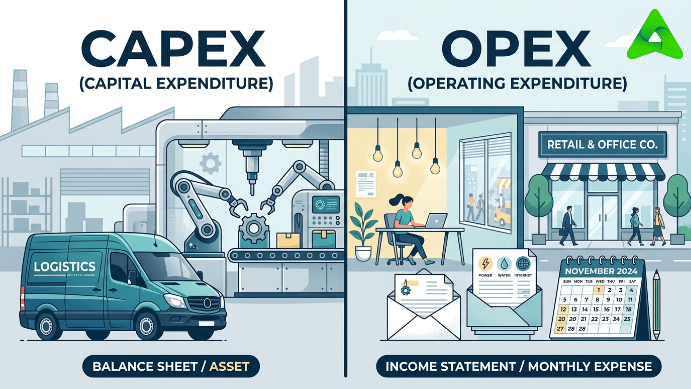
In business, that “car” is CAPEX, and the “petrol and oil” are OPEX. Let’s break down exactly what they mean and how they shake up your financial statements.
1. CAPEX (Capital Expenditures): The Major Investments
CAPEX is the money your business spends to buy, improve, or maintain long-term physical assets. These are things that will benefit your business for more than one year.
- Examples: Buying a delivery van, purchasing a building, upgrading manufacturing machinery, or buying specialised software licenses.
- The Layman’s Rule: If it’s a big-ticket item that becomes a “property” of the business and lasts a long time, it’s CAPEX.
How CAPEX Impacts Your Financial Statements
You might think spending $50,000 on a new machine would instantly wipe out $50,000 of your profits this month. Surprisingly, it doesn’t.
- The Balance Sheet (Big Impact): Because a CAPEX purchase has long-term value, it is listed as an Asset. Your cash decreases by RM50,000, but your “Equipment” asset increases by RM50,000. Your business’s overall net worth stays the same on paper.
- The Income Statement (Delayed Impact): You do not deduct the full cost of CAPEX from your taxes or profits right away. Instead, you wear it down over time through Depreciation. If that RM50,000 machine is expected to last 5 years, you will record an expense of RM10,000 each year for 5 years.
- The Cash Flow Statement (Immediate Impact): This is where the reality check happens. Even if your Income Statement looks unaffected, your Cash Flow Statement will show an immediate, large cash outflow under “Investing Activities” because the cash is physically gone.
2. OPEX (Operating Expenses): The Day-to-Day Costs
OPEX is the money you spend on the day-to-day operations that keep your business open and running. These costs are fully expended within the current year.
- Examples: Rent, office utilities, employee salaries, marketing costs, insurance, and office supplies.
- The Layman’s Rule: If it’s a recurring bill you pay just to keep the lights on and the business functioning week to week, it’s OPEX.
How OPEX Impacts Your Financial Statements
OPEX is much more straightforward than CAPEX because it represents immediate consumption.
- The Income Statement (Immediate Impact): OPEX is deducted directly from your revenue in the exact month or year it happens. If you pay RM2,000 for rent this month, that RM2,000 directly reduces your net profit for this month.
- The Balance Sheet (No Direct Asset Impact): Paying for OPEX doesn’t build equity or create assets. Once you pay the rent or the electric bill, that money is gone; you don’t own the building or the power grid.
- The Cash Flow Statement (Immediate Impact): OPEX shows up under “Operating Activities” as a regular, continuous drain on cash.
At a Glance: CAPEX vs. OPEX
Feature | CAPEX (Capital Expenditure) | OPEX (Operating Expense) |
|---|---|---|
Purpose | Buying long-term assets to grow the business. | Running the day-to-day business. |
Lifespan | Benefits the business for multiple years. | Used up within one year (or less). |
Primary Statement | Hits the Balance Sheet first as an asset. | Hits the Income Statement immediately as an expense. |
Tax Impact | Deducted slowly over time (Depreciation). | Fully deducted in the current tax year. |
Cash Impact | Large, one-time cash outflow. | Frequent, predictable cash outflows. |
Why the Balance Matters: A Strategic Example
Choosing how to categorize your expenses isn’t just a task for your accountant, it’s a powerful tool for cash flow management.
Take your company’s IT needs, for example. You could choose to buy servers outright for RM15,000. That’s CAPEX. You’ll need a lot of cash upfront, and you’ll depreciate it over several years.
Alternatively, you could opt for a monthly cloud computing subscription. That’s OPEX. There is no massive upfront cost, it’s easier on your immediate cash flow, and the expense is fully tax-deductible this year. Neither option is universally “right,” but one will align much better with your current business goals than the other.
Take Control of Your Financial Strategy with Adventus Business Consult
Balancing CAPEX and OPEX effectively can mean the difference between a business that struggles to find cash and one that is primed for healthy, sustainable growth. Getting this balance right affects your tax liabilities, your business valuation, and your attractiveness to lenders or investors.
Don’t leave your financial strategy to guesswork. At Adventus Business Consult, we work alongside small business owners to optimise cash flow, structure expenditures for maximum tax benefit, and build financial statements that tell a powerful story of success.
Ready to gain total clarity over your business numbers? Contact Adventus Business Consult today to schedule a financial strategy session, and let’s turn your everyday expenses into a roadmap for growth.