Mastering the Maze: The Most Efficient Ways to Manage Your Inventory
Whether you’re running a small e-commerce shop or a sprawling warehouse, inventory is likely your biggest asset and your biggest headache. If you have too much, your cash is tied up in “dead stock.” If you have too little, you face the dreaded “out of stock” notification and lose customer trust.
Finding the “sweet spot” isn’t about luck; it’s about applying the right frameworks. Here is how to master your stock management and why the humble stock take is actually your secret weapon.
1. Prioritize with ABC Analysis
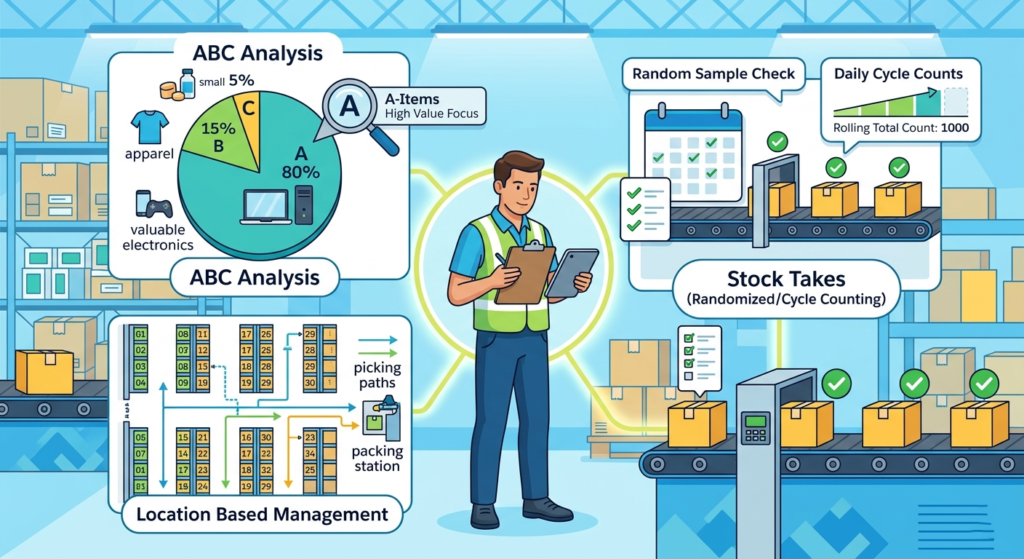
Not all inventory is created equal. The ABC Analysis is based on the Pareto Principle (the 80/20 rule), which suggests that a small percentage of your items typically accounts for the majority of your consumption value.
- A-Items: These are your VIPs. They make up about 10–20% of your total inventory but account for 70–80% of your value. These require tight control and frequent stock takes.
- B-Items: The middle class. They represent about 30% of your stock and 15–20% of your value. Monitor these with moderate frequency.
- C-Items: The “cheap and cheerful” category. They represent nearly 50% of your inventory but only about 5% of your value. Don’t over-invest time here; keep enough on hand to avoid hassle, but check them less often.
2. Organize via Location-Based Management
If your team spends more time finding items than picking them, your efficiency is leaking. A location-based system assigns every SKU a specific “home” (aisle, shelf, bin).
Pro Tip: Use Velocity-Based Slotting. Place your “A-Items” (high-frequency movers) closest to the packing station to minimize travel time.
3. The Power of the Stock Take
Many businesses view the annual stock take as a necessary evil, a long weekend of counting dusty boxes. However, regular verification is the only way to catch shrinkage (theft, damage, or administrative errors) before it ruins your margins.
To make stock takes efficient, stop doing them all at once. Instead, use these two methods:
Randomized Sampling
Instead of counting everything, choose a random selection of SKUs to verify each week. This acts as a “spot check.” If the random sample is highly accurate, you can trust your system. If not, it’s a red flag that your processes are breaking down.
Cycle Counting
This is the gold standard for modern warehouses. You count a small subset of inventory every single day. By the end of the quarter or year, you’ve counted everything at least once without ever having to shut down operations.
Summary Table: Which Strategy to Use?
Strategy | Best For | Key Benefit |
|---|---|---|
ABC Analysis | Maximizing ROI | Focuses effort where the money is. |
Location-Based | Speed & Accuracy | Reduces “search time” and picking errors. |
Random Sampling | Quick Health Checks | Identifies systemic issues without a full count. |
Cycle Counting | Operational Continuity | Eliminates the need for annual shutdowns. |
The Bottom Line
Efficiency in inventory management is about visibility. When you know exactly what you have (ABC Analysis), where it is (Location-Based), and you verify it regularly (Stock Takes), you stop reacting to crises and start scaling your business.
Ready to stop counting and start growing? Pick one category of items this week and perform a randomized spot check. You might be surprised by what you find.
Stop guessing and start growing.
If your manual stock takes are draining your team’s time, it might be time for a smarter system.