Payroll in Malaysia: Why Compliance Beats Calculation
In many small-to-medium businesses, payroll is often viewed as a “month-end chore”, a few hours spent punching numbers into a spreadsheet to ensure employees get their money on time.
But if you’re operating in Malaysia in 2026, viewing payroll as a simple math problem is a dangerous game. In our current regulatory landscape, payroll isn’t just about financial accuracy; it’s a high-stakes exercise in statutory compliance.
Here’s why shifting your perspective from “calculating salaries” to “managing compliance” is essential for your business survival.
1. The “Big Four” and the 15th-Day Rule
In Malaysia, payroll is governed by four primary statutory bodies. Missing a deadline or miscalculating a contribution doesn’t just annoy your staff; it triggers automatic penalties.
- EPF (KWSP): Mandatory retirement savings. Remember that for employees earning RM5,000 and below, the employer’s share is 13%, while it’s 12% for those above that threshold.
- SOCSO (PERKESO): Provides social security. As of 2026, we’ve seen the enforcement of the Skim Kemalangan Bukan Bencana Kerja (SKBBK), expanding protection to non-employment injuries. This adds a new layer of reporting (the 13-field text file format) that manual systems often miss.
- EIS (SIP): Unemployment insurance. Small percentages, but high importance for retrenchment compliance.
- PCB (MTD): Monthly Tax Deductions. This is LHDN’s way of ensuring they get their cut throughout the year rather than in one lump sum.
The Golden Rule: All payments for the previous month must reach these bodies by the 15th of the current month. Even a day late can result in fines or interest charges that eat into your margins.
2. The 2026 Compliance Shift: Beyond the Basics
Compliance isn’t static. In the last year alone, we’ve seen significant shifts that have turned “standard” payroll on its head:
- LINDUNG 24/7: The new SOCSO amendments mean employers now facilitate contributions for 24-hour coverage. If your payroll logic hasn’t been updated to reflect the latest salary ceiling (capped at RM6,000), you’re already non-compliant.
- Digital Reporting (e-Data Praisi): LHDN is moving aggressively toward automation. Filing Form E and CP8D is no longer just about the numbers; it’s about the format. If your data isn’t structured for the MyTax portal, you risk rejection and late-filing penalties of up to RM20,000.
- Contract Stamping: Following the 2026 Budget, the threshold for stamp duty on employment contracts has been revised. Ensuring your payroll records match your stamped contracts is now a common audit checkpoint.
3. The Real Cost of “Getting it Wrong”
Think a small mistake won’t be noticed? The authorities have digitized. LHDN and SOCSO systems now talk to each other. Discrepancies between your PCB filings and your SOCSO contributions act as a giant “Audit Me” sign.
Offence | Typical Penalty |
|---|---|
Late PCB Payment | 10% penalty on the unpaid amount. |
Failure to provide Form EA | Fine of RM200 to RM20,000 or imprisonment. |
Under-declaring SOCSO | RM10 per day per employee + potential prosecution. |
Incorrect Tax Info | 200% of the tax undercharged. |
4. Moving From Manual to Mandatory Compliance
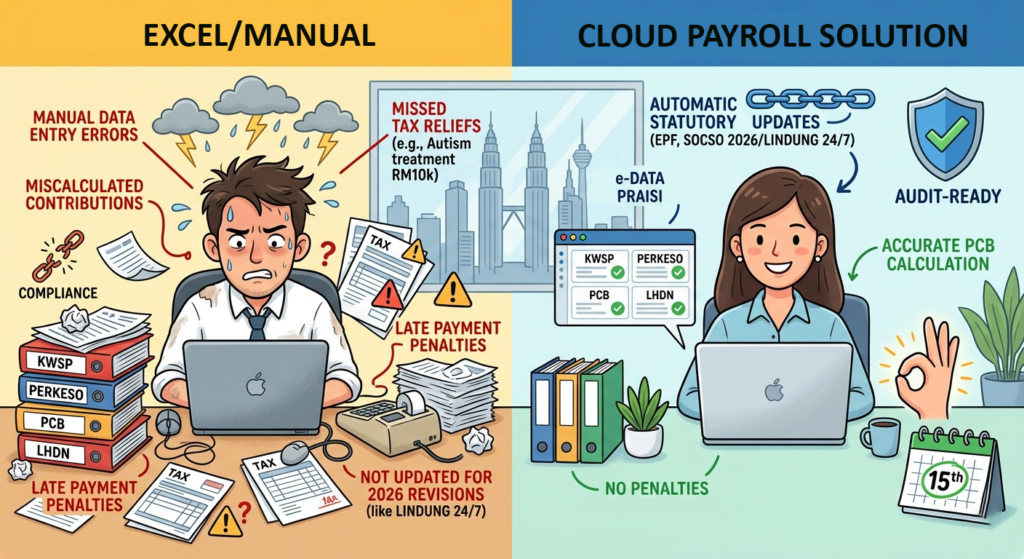
If you are still using Excel to manage your payroll, you aren’t just being “old school”, you’re taking an unnecessary risk. Manual entry is the leading cause of:
- Rounding Errors: LHDN and EPF have specific rounding rules (e.g., EPF is rounded to the nearest Ringgit, but only for the final amount).
- Missing Tax Reliefs: With new 2026 reliefs for autism treatment (up to RM10,000) and sustainable lifestyle purchases, failing to update your PCB logic means your employees are overpaying tax, leading to dissatisfaction.
The Bottom Line
In Malaysia, payroll is a legal obligation disguised as a financial task. It requires staying updated on every Budget announcement, every KESUMA (Ministry of Human Resources) update, and every LHDN circular.
If you want to sleep soundly on the 15th of every month, stop asking “Is the math right?” and start asking “Are we compliant?”
Is your current payroll process ready for a KESUMA audit? Let’s discuss how you can automate your compliance so you can focus on growing your business.