Malaysian Employment Act 1955 Section 101C: Employee or Contractor?
In the modern business landscape, flexibility is king.
Many businesses in Malaysia rely heavily on freelancers, gig workers, and independent contractors to scale up operations without the long-term commitments of full-time hiring.
However, if your business regularly engages external talent, a critical legal shift deserves your immediate attention: Section 101C, introduced into the Employment Act 1955 via the Employment (Amendment) Act 2022, which officially came into force on January 1, 2023.
This amendment completely changes the rules of engagement. If a dispute arises, the law now assumes a worker is your formal employee unless you can prove otherwise.
Here is what Section 101C means for your business, broken down into plain English.
Flip the Script: The Burden of Proof Shift
Historically, if a freelancer claimed they were treated like an employee and demanded statutory benefits (like EPF, SOCSO, or overtime), the burden was on them to prove that an employer-employee relationship existed.
Section 101C turns that completely upside down.
The New Reality: In the absence of a watertight written contract, the law automatically presumes a worker is a formal employee. The burden of proof shifts entirely to the hiring party (the business) to legally disprove this assumption.
If you cannot prove they are genuinely an independent contractor, you could be hit with heavy penalties, including backdated statutory contributions and unpaid benefits.
The 6 Statutory Flags: When is a Contractor Presumed an Employee?
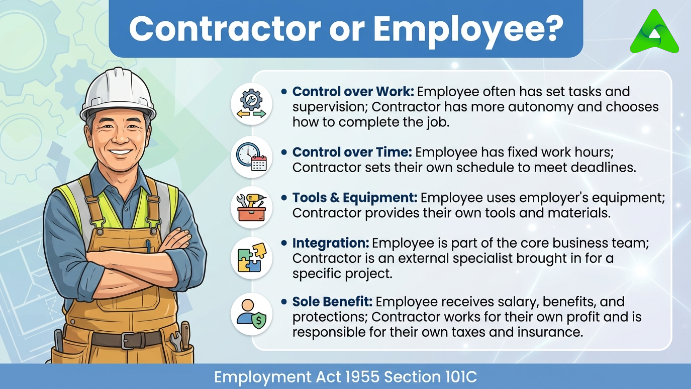
The law looks past fancy job titles or the name of your contract. Instead, it looks at the actual day-to-day working reality. Under Section 101C, a worker is legally presumed to be an employee if any of the following conditions are met:
Factor | Description of Employee Presumption |
|---|---|
Control over Work | You dictate how and where they do their work. |
Control over Time | You set their exact working hours or shifts. |
Tools & Equipment | You provide them with the laptop, software, or tools to do the job. |
Integration | Their work forms an integral, core part of your daily business operations. |
Sole Benefit | They work exclusively for your business and cannot take other clients. |
Payment Structure | They are paid regular, recurring amounts that make up the majority of their income. |
The Financial and Legal Risks of Misclassification
Misclassifying your staff, even accidentally, carries steep consequences under the updated Employment Act. If Human Resources or the Ministry of Human Resources (MOHR) determines your “freelancer” is legally an employee, your business faces:
- Backdated Financial Liabilities: You may be forced to pay back-dated contributions for EPF, SOCSO, and EIS, alongside statutory annual leave, sick leave, and overtime.
- Legal Penalties & Fines: Failing to comply with the Employment Act can result in hefty corporate fines and reputational damage.
- Industrial Court Claims: Misclassified contractors who are let go can file for unfair dismissal, leading to costly legal battles and potential reinstatement orders.
Action Steps for Malaysian Businesses
To safeguard your organization against accidental employee presumption, take these proactive steps:
1. Audit Your Existing Agreements
Review all active freelancer, vendor, and consultant agreements. Ensure they are clearly drafted as a “Contract for Service” (independent contractor) rather than a “Contract of Service” (employment contract).
2. Loosen the Reins on Independent Contractors
If you are paying someone as a freelancer, treat them like one. Avoid tracking their daily hours, demanding strict exclusivity, or providing them with corporate equipment unless absolutely necessary for security. Focus on deliverables, not hours clocked.
3. Transition When Necessary
If a freelancer’s role has evolved to the point where they operate like a core team member (regular monthly pay, fixed hours, fully integrated), it may be time to formally transition them into a part-time or full-time employee to avoid regulatory non-compliance.