Director Remuneration Rules for Malaysian Sdn Bhd
Paying Yourself as a Director of Your Sdn Bhd? Here’s What Every Business Owner Should Know.
Many owners of small private limited companies (Sdn Bhd) assume they can simply transfer money from the company’s bank account to their personal account whenever they need it.
After all, “It’s my company.”
Unfortunately, that’s not how Malaysian company law works.
Whether you’re paying yourself a monthly salary, director’s fees, bonuses, or even enjoying benefits such as a company car or accommodation, there are legal and tax obligations that every company director should understand.
Failing to comply can expose both the company and its directors to financial penalties, tax issues, and even criminal liability.
A Company Is a Separate Legal Entity
One of the biggest misconceptions among small business owners is that company money is their personal money.
A Sdn Bhd is a separate legal entity from its shareholders and directors. This means any payment made to a director must be properly authorised and recorded.
Good governance isn’t just for large corporations, it applies to every company, regardless of size.
Director Remuneration Must Be Properly Approved
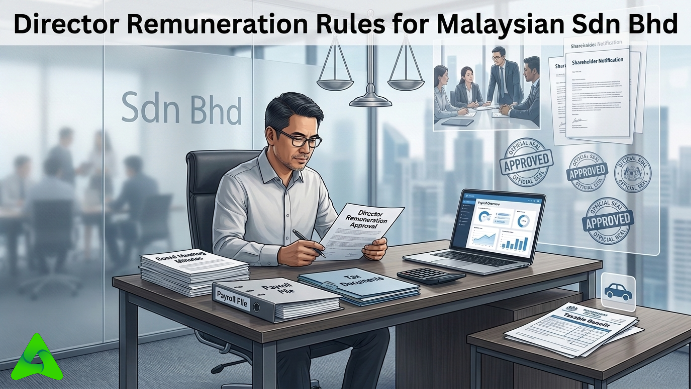
Under Section 230 of the Companies Act 2016, a private company cannot simply decide to pay a director without following the required approval process.
The board of directors must:
- Formally approve the director’s remuneration and benefits.
- Record the approval in board meeting minutes.
- Notify shareholders in writing within 14 days of the approval.
Shareholders holding at least 10% of the company’s voting rights have 30 days from receiving the notice to object and require the matter to be approved through a shareholders’ resolution.
If the required approval is ultimately not obtained, the remuneration paid becomes a debt owed by the director back to the company under Section 230(5).
For public companies, the rules are even stricter, with director fees requiring approval at a general meeting and breaches potentially attracting fines of up to RM3 million.
“Tax-Free Salary” Is Illegal
Some business owners mistakenly believe they can structure a director’s remuneration package as “tax-free”, with the company paying the income tax on behalf of the director.
This is specifically prohibited.
Section 226 of the Companies Act 2016 states that a company must not pay or promise remuneration that is described as tax-free or calculated based on the director’s income tax.
Any such arrangement is automatically treated as a gross taxable amount, meaning the remuneration remains fully subject to income tax.
More importantly, both the company and every officer involved may be committing a criminal offence that carries penalties of up to:
- Five years’ imprisonment;
- A fine of up to RM3 million; or
- Both.
Almost Every Benefit Is Taxable
Receiving remuneration doesn’t only mean drawing a monthly salary.
Under Section 13(1) of the Income Tax Act 1967, director remuneration includes:
- Salary
- Director’s fees
- Bonuses
- Commissions
- Allowances
- Perquisites
- Benefits-in-kind such as:
- Company vehicles
- Free accommodation
- Other non-cash benefits
Section 13(2)(d) further confirms that these rules apply simply because the individual is a director of a Malaysian-resident company, even if there is no formal employment contract.
In other words, calling a payment something else does not necessarily make it non-taxable.
Good Documentation Protects Everyone
Proper documentation is just as important as making the payment itself.
Business owners should ensure they maintain:
- Board resolutions approving remuneration.
- Board meeting minutes.
- Written notices to shareholders where required.
- Payroll records.
- Tax deductions and statutory contributions where applicable.
- Supporting documents for benefits-in-kind.
Good documentation not only satisfies legal requirements but also provides valuable evidence during tax audits, company audits, or shareholder disputes.
Don’t Treat Your Company Like a Personal Bank Account
It is common for entrepreneurs to blur the line between personal and company finances, especially during the early years of a business.
However, once you operate through a Sdn Bhd, every payment made to directors should be properly authorised, documented, and taxed where required.
Following the correct procedures helps protect:
- The company.
- Its directors.
- Its shareholders.
- Its reputation.
A few minutes spent preparing proper resolutions and maintaining accurate payroll records can prevent costly legal and tax consequences later.
At Adventus Business Consult, we help Malaysian SMEs stay compliant through our outsourced accounting and payroll services. Whether you’re setting up payroll for directors, maintaining statutory compliance, or ensuring your remuneration is properly documented, our team can guide you every step of the way.