The Cost of Inaction
Why Standing Still Is the Most Expensive Business Decision
In today’s business environment, transformation and digitalisation are no longer ambitious initiatives reserved for market leaders or tech giants.
They are survival imperatives. Yet, many organisations continue to delay change, waiting for clearer signals, better timing, more certainty, or perfect readiness.
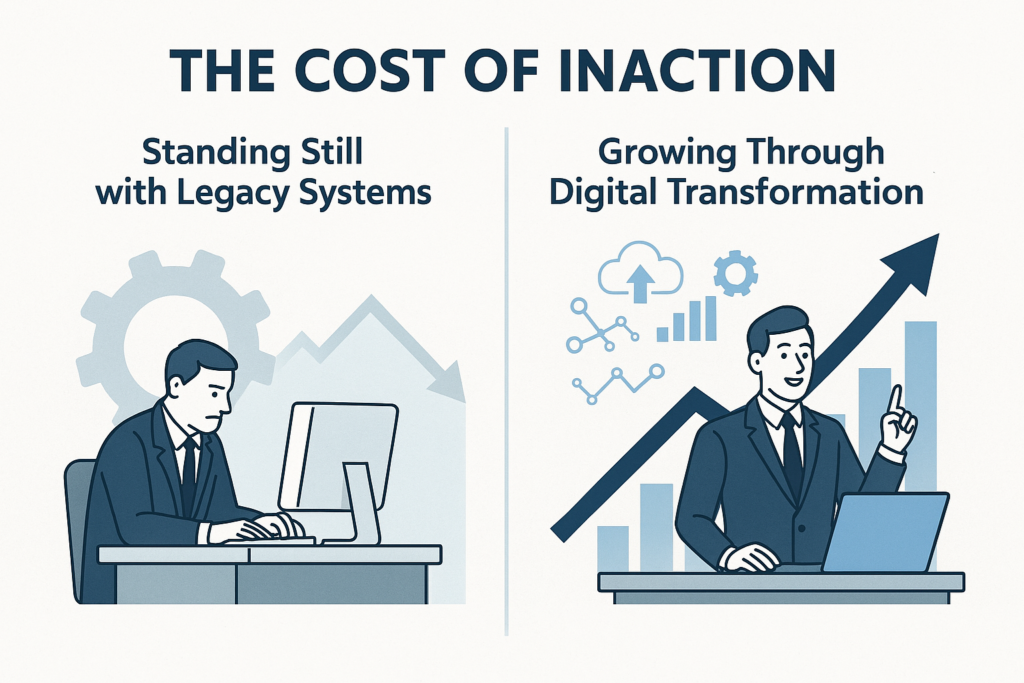
What often goes unspoken is this:
Inaction has a cost.
And in many cases, it is far greater than the cost of transformation itself.
Inaction Is Still a Decision
Business leaders often frame transformation as a risky move, large investments, cultural disruption, and uncertain returns.
But choosing not to transform is also a strategic decision, one that carries compounding consequences over time.
Markets evolve. Customer expectations reset. Talent priorities shift. Technology advances with or without your organisation. When a business delays digitalisation, it doesn’t pause the world around it, it simply falls behind it.
The cost of inaction is rarely immediate. It accumulates quietly, eroding competitiveness, resilience, and relevance.
The Hidden Costs of Not Transforming
1. Lost Competitive Advantage
Digital-first competitors, often leaner and more agile, can launch faster, personalise better, and operate more efficiently. Businesses relying on legacy systems and manual processes struggle to match speed and cost.
Over time, this gap widens. What starts as “slightly less efficient” becomes “structurally uncompetitive.”
Customers notice. Markets respond.
2. Eroding Customer Trust and Loyalty
Today’s customers expect seamless, intuitive, and responsive experiences, whether B2C or B2B. Slow response times, inconsistent service, and outdated interfaces all signal one thing: a business that isn’t keeping up.
When digital touchpoints lag behind expectations, customers don’t complain, they leave.
The cost here isn’t just lost revenue; it’s lost lifetime value.
3. Operational Inefficiency and Rising Costs
Manual workarounds, fragmented systems, and duplicated effort consume time and resources every day. While these may feel “manageable,” they scale poorly.
As the business grows, or faces economic pressure, inefficiencies become expensive bottlenecks. Digitalisation is not just about innovation; it’s about sustainable efficiency.
Inaction forces organisations to pay more to achieve less.
4. Talent Drain and Engagement Decline
The modern workforce expects digital tools that enable productivity, flexibility, and collaboration. Outdated systems frustrate employees, slow them down, and ultimately push high performers to look elsewhere.
Transformation isn’t only about customers, it’s about empowering people.
Failing to invest in digital capability is often reflected in higher turnover, lower engagement, and a struggle to attract future-ready talent.
5. Reduced Organisational Resilience
Recent global disruptions, from pandemics to supply chain shocks, have shown the value of digital agility. Businesses with cloud infrastructure, data visibility, and automated processes adapted faster.
Those without struggled, or failed entirely.
Inaction leaves organisations exposed, brittle, and slow to respond when conditions change.
Transformation Is Not a One-Time Event
One of the biggest misconceptions about digital transformation is that it is a single project with a finish line. In reality, transformation is a continuous process of adapting business models, operations, and mindsets.
Waiting for “the right time” often means waiting too long.
Successful organisations don’t ask, “Should we transform?”
They ask, “How fast can we learn and adapt?”
The Real Risk Is Delay
There is, of course, risk in transformation, financial, operational, and cultural. But these risks are visible, measurable, and manageable. The risk of inaction is harder to see, which is why it is so dangerous.
By the time the impact becomes obvious, declining market share, shrinking margins, talent loss, it is often much harder and more expensive to recover.
At that point, transformation becomes reactive rather than strategic.
Moving Forward: From Awareness to Action
Transformation does not have to be overwhelming. It starts with clarity:
- Identify where friction exists in customer and employee journeys
- Understand which processes consume time without adding value
- Use data to inform decisions rather than validate assumptions
- Break transformation into focused, achievable phases
The goal is not digital for digital’s sake. The goal is to future-proof the business.
Final Thought: The Most Expensive Option Is Doing Nothing
Every organisation is on a transformation journey, whether intentionally or by default. The question is not if change will happen, but whether you will lead it or be forced into it.
In today’s environment, standing still is not neutral. It is a slow but certain decline.
The cost of inaction is paid daily, in lost opportunities, wasted effort, disengaged people, and fading relevance.
And unlike investment in transformation, it delivers no return.
Inaction is not a holding pattern, it’s a cost that compounds every day. If you’re ready to move from awareness to action, now is the time to start shaping your transformation rather than reacting to it later.
How Adventus Can Help
At Adventus, we help organisations move forward with clarity and confidence.
Whether you are just beginning to explore digital transformation or looking to accelerate existing initiatives, we work with you to identify real business pain points, prioritise practical opportunities, and design transformation journeys that deliver measurable impact.
Our approach combines strategy, technology, and people, ensuring change is not just implemented, but adopted and sustainable.
If you’re ready to take the first step, Adventus is ready to walk that journey with you.