Payroll Essentials for Malaysian Startups
Hiring your first employee is a major milestone, but Malaysia’s payroll and compliance requirements can feel confusing if you’re new to them.
Understanding the essentials early helps you avoid costly mistakes and build trust with your team from day one.
Here’s what every Malaysian startup founders should know.
1. The Statutory Basics You Must Get Right
EPF (Employees Provident Fund)
- Malaysian employees under 60: Employers contribute 13% (≤ RM5,000 salary) or 12% (> RM5,000); employees contribute 11%.
- Mandatory EPF for foreign workers began October 2025: 2% employer + 2% employee.
SOCSO (PERKESO)
- Provides workplace injury and invalidity protection.
- Contributions follow salary‑based tables capped at RM6,000.
EIS (Employment Insurance System)
- The Employment Insurance System (EIS), also known as Sistem Insurans Pekerjaan (SIP), is a financial safety net designed to protect private-sector employees who lose their jobs.
- Managed by the Social Security Organisation (SOCSO), it was implemented in 2018 to ensure that workers aren’t left stranded during periods of unemployment.
- Contribution Rate: 0.4% of the employee’s monthly salary (split equally: 0.2% from the employer and 0.2% from the employee).
- Coverage: It is mandatory for all private-sector employees aged 18 to 60 who are Malaysian citizens or permanent residents.
Minimum Wage
- The Minimum Wages Order 2024 standardized the minimum wage to RM1,700.00 nationwide beginning 1 Feb 2025 for larger employers and 1 Aug 2025 for micro‑enterprises.
2. Register Before Paying Your First Salary
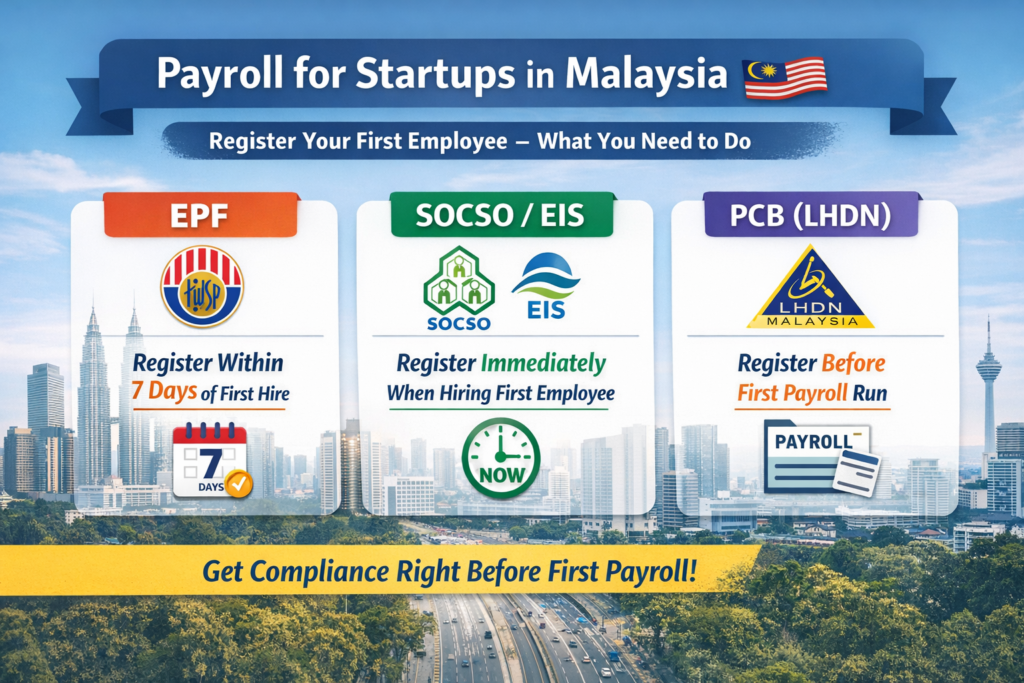
Startups must register with:
- EPF within 7 days of hiring the first employee
- SOCSO & EIS under PERKESO, and LHDN for PCB (Monthly Tax Deduction), before running the first payroll.
Best practice:
To avoid delays and penalties, it’s best to register with EPF, SOCSO/EIS, and LHDN immediately upon hiring your first employee.
3. Know What Counts as “Wages”
Included under EPF/SOCSO:
- Basic salary
- Bonuses
- Allowances
- Commissions
- Payouts for unused annual leave
Not included: overtime, travel allowances, director’s fees, termination benefits, gifts, benefits‑in‑kind.
4. Common SME Payroll Mistakes
Using wrong or outdated statutory contribution rates.
This is the most common and the most serious compliance issue.
Startups often rely on old payroll settings and forget to update changes such as:
- EPF becoming mandatory for foreign workers (from October 2025)
- SOCSO/EIS wage ceiling increasing from RM4,000 to RM6,000
5. Hiring Foreign Talent? Extra Steps Apply
Foreign employees require the correct Employment Pass classification, proper right‑to‑work checks, and payroll setup aligned with Malaysian regulations.
With mandatory EPF contributions for foreign workers kicking in (2% + 2%), accuracy matters more than ever.
Let Adventus Handle Payroll While You Focus on Growth
Malaysia’s payroll framework is detailed, and founders shouldn’t be spending hours wrestling with EPF tables, SOCSO wage bands, or regulatory updates.
Adventus helps startups by handling:
- Monthly payroll processing
- EPF, SOCSO, EIS & PCB compliance
- Local + foreign employee statutory requirements
- Registrations with EPF, SOCSO & LHDN
- Error‑free, on‑time submissions