The “Sikit-Sikit” Effect
How “Small Gaps” Are Costing Your Business
In many Malaysian micro and small businesses, major financial problems rarely start as major problems.
They begin as small, everyday gaps, the kind that seem harmless at first.
- A stock count that’s slightly off.
- A sale recorded a day late.
- Two systems that don’t quite match.
- A decision made based on “agak-agak”.
Individually, these don’t feel urgent.
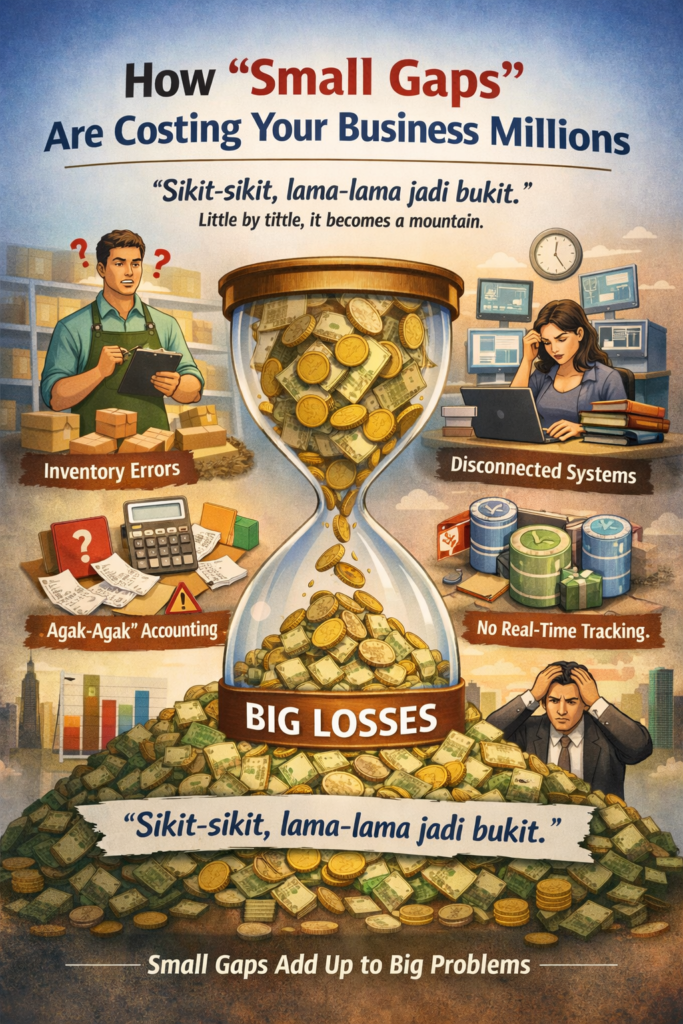
But as the Malay proverb goes: “Sikit-sikit, lama-lama jadi bukit.”
Over time, these small gaps quietly accumulate, and that’s when they start costing your business serious money.
The Reality for Malaysian SMEs
Whether you run a trading business or a service-based company, the challenges are surprisingly similar.
You’re focused on growth, customers, and daily operations. Systems evolve organically. Processes are often manual or loosely structured. And reporting? It’s done when there’s time.
This is where gaps begin.
Not because of negligence, but because the business has outgrown its processes.
Common “Small Gaps” That Lead to Big Problems
1. Inventory That Doesn’t Match Reality
Many SMEs purchase inventory in bulk but track it manually, or across multiple spreadsheets and systems.
Over time:
- Physical stock doesn’t match system records
- Items go missing, expire, or are miscounted
- Sales are recorded, but inventory isn’t properly deducted
The result?
You may think you’re making money on certain products — but you’re actually losing margin without realizing it.
2. Disconnected Systems and Data Silos
It’s common to see businesses using:
- One system for sales
- Another for accounting
- Another for inventory
- And spreadsheets to “tie everything together”
When systems don’t talk to each other:
- Data becomes inconsistent
- Reports don’t align
- Time is wasted reconciling numbers
Worse, business owners start relying on estimates instead of facts.
3. “Agak-Agak” Accounting
This is more common than many realise.
When financial records are not updated regularly or accurately, decisions are made based on:
- Rough cash balances
- Estimated profits
- Incomplete reports
This “agak-agak” approach might work in the early days, but as the business grows, it becomes risky.
You could be:
- Underpricing your services
- Overspending without noticing
- Expanding without knowing your true cash position
4. Lack of Real-Time Visibility
For service-based businesses, the gaps are less visible, but just as damaging.
Examples include:
- Unbilled work or delayed invoicing
- Poor tracking of project costs
- Payroll not aligned with actual productivity
Without real-time tracking:
- Revenue leaks occur
- Profitability by client or project is unclear
- Cash flow becomes unpredictable
Why These Gaps Get Worse Over Time
At the start, the impact is small.
But as your business grows:
- Transaction volumes increase
- More staff get involved
- Processes become more complex
Small inefficiencies multiply.
What used to be a minor discrepancy becomes:
- Thousands in lost inventory
- Months of inaccurate reporting
- Poor strategic decisions
And by the time it’s noticed, the financial impact is already significant.
The Hidden Cost: Not Just Money
These gaps don’t just affect profits.
They also lead to:
- Stress and uncertainty for business owners
- Lack of confidence in financial reports
- Difficulty in securing loans or investors
- Compliance risks with LHDN and audits
In short, they limit your ability to scale confidently.
Closing the Gaps: What SMEs Should Focus On
The goal isn’t perfection, it’s visibility and consistency.
Here’s where to start:
1. Improve Data Accuracy at the Source
Ensure transactions are recorded correctly and timely, whether it’s sales, purchases, or expenses.
2. Integrate Systems Where Possible
Reduce reliance on disconnected tools and manual reconciliation.
3. Move Away from “Agak-Agak”
Make decisions based on real numbers, not estimates.
4. Establish Simple, Consistent Processes
Even basic standardisation can eliminate many small errors.
5. Review Regularly
Don’t wait until year-end. Monthly reviews can catch issues early.
How Adventus Helps
At Adventus Business Consult, we work with Malaysian SMEs to identify and close these “small gaps” before they become major problems.
Our approach focuses on:
- Clean, accurate, and timely financial data
- Integrated, cloud-based accounting systems
- Real-time visibility into business performance
- Ongoing support to ensure consistency
So you can stop guessing, and start making confident, data-driven decisions.
Final Thought
Most businesses don’t fail because of one big mistake.
They struggle because of small gaps that go unnoticed for too long.
Remember: “Sikit-sikit, lama-lama jadi bukit.”
The sooner you address these gaps, the stronger your foundation for growth.
Most SMEs don’t realise that these small, everyday gaps are actually layers of risk building up over time.
We break this down further using the Swiss Cheese Theory, and how you can prevent these gaps from lining up, in our full article here:
The Swiss Cheese Theory
A Practical Approach to Risk Management for Small Businesses
Need help identifying the gaps in your business?
Get in touch with Adventus Business Consult today and let us help you turn your numbers into clear, actionable insights.