Are Your Expense Accounts Hiding Business Problems?
Many small business owners focus on one question when looking at their accounts:
“Are we making a profit?”
But a more important question is:
“Can we trust the numbers behind that profit?”
Your financial statements are only as useful as the information that goes into them. If expenses are placed into broad, unclear categories, your accounts may look complete, but they may not provide the insights needed to make better business decisions.
One of the most common issues we see in small businesses is the overuse of accounts such as:
- General Expenses
- Miscellaneous Expenses
- Other Expenses
- Sundry Expenses
- Other Income
- Other Receivables
- Other Payables
These accounts may seem convenient, but they can create problems when they become a dumping ground for transactions that do not have a proper classification.
Why Are These Accounts Risky?
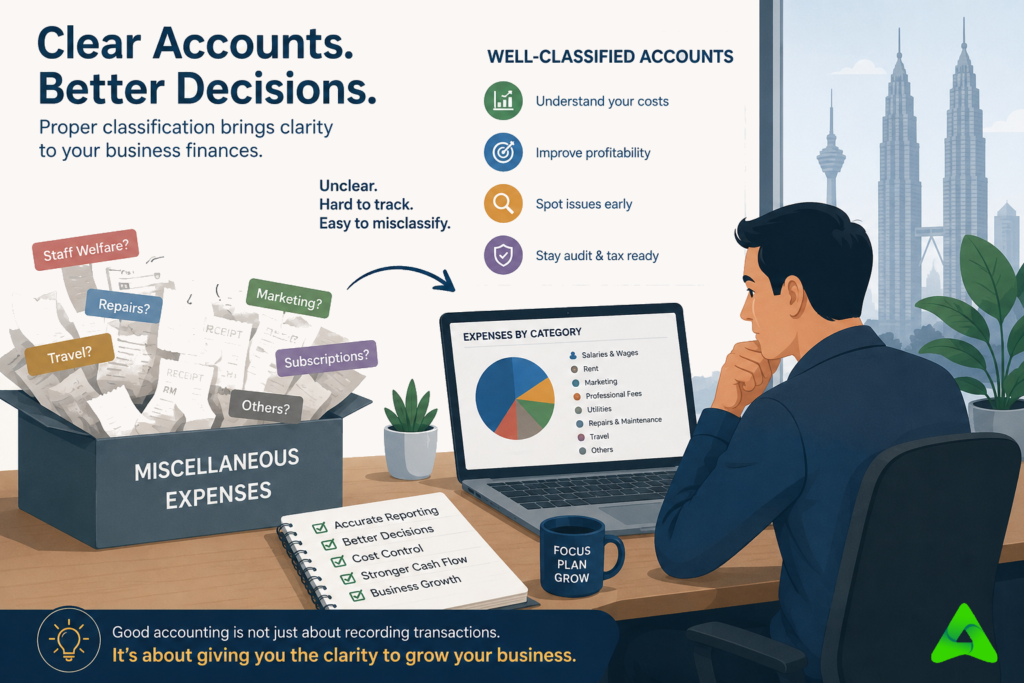
Imagine seeing “Miscellaneous Expenses” of RM50,000 in your profit and loss statement.
What does that tell you?
Is it:
- Staff welfare?
- Repairs and maintenance?
- Professional fees?
- Marketing expenses?
- Software subscriptions?
- Business travel?
- Personal expenses accidentally charged to the company?
Without proper classification, you lose visibility into where your money is actually going.
For a small business owner, this matters because every ringgit spent should help answer important questions:
- Which costs are increasing?
- Which areas are affecting profitability?
- Are we spending money on activities that generate returns?
- Where can we improve efficiency?
Common Accounts That Require Extra Attention
1. General Expenses / Miscellaneous Expenses
These should only be used for genuinely uncommon or insignificant items.
If the balance keeps growing every month, it is usually a sign that expenses are not being reviewed properly.
A business should not need to search through a long list of miscellaneous transactions just to understand its operating costs.
2. Other Expenses
This account is often used when someone is unsure where a transaction belongs.
While acceptable for rare situations, frequent use can hide important cost categories.
For example, a business spending heavily on software subscriptions, advertising, or training should have separate accounts so management can track these investments.
3. Other Income
Not all income has the same meaning.
A business owner needs to know the difference between:
- Revenue from customers
- Interest income
- Government grants
- One-off gains
- Disposal of assets
Combining them together can give a misleading picture of business performance.
4. Director’s / Shareholder’s Accounts
For many SMEs, especially owner-managed businesses, personal and business transactions can sometimes get mixed.
Examples:
- The owner pays company expenses personally
- The company pays personal expenses temporarily
- Withdrawals are not properly recorded
These should be tracked properly because they affect the true financial position of the business.
5. Suspense Accounts
A suspense account should be a temporary holding area, not a permanent home for unexplained transactions.
If amounts remain there for months, it usually means there are unresolved accounting issues that need attention.
6. Advances, Deposits and Prepayments
These accounts are often misunderstood.
For example:
- A deposit paid to a supplier is not always an expense
- Annual software subscriptions may need to be spread over the period used
- Customer deposits may not yet be revenue
Incorrect classification can affect both profitability reporting and tax preparation.
Why This Matters More for Small Businesses
Large companies often have finance teams reviewing accounts regularly.
For many Malaysian SMEs, the business owner is also the decision maker, sales person, and operations manager.
Your accounts should not only satisfy compliance requirements, they should help you run the business.
Poor account classification can lead to:
- Incorrect profit reporting
- Poor budgeting decisions
- Difficulty identifying unnecessary spending
- Problems during tax preparation or audit
- Lack of confidence in financial reports
Good accounting is not just about recording transactions.
It is about creating information that helps you make better decisions.
A Simple Practice: Review Your Chart of Accounts Regularly
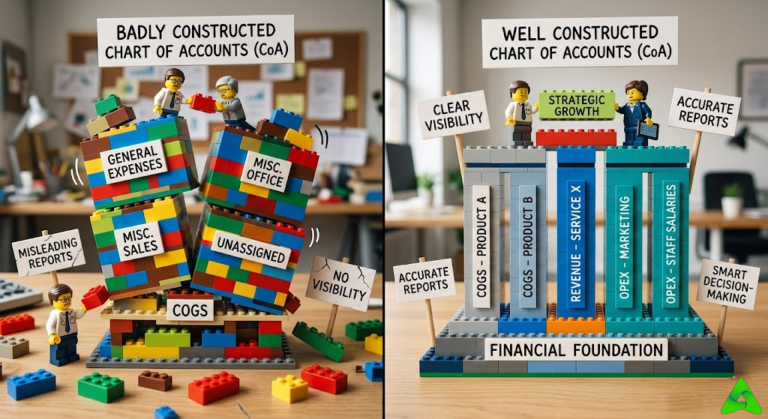
A well-structured chart of accounts should make it easy to understand:
- Where your revenue comes from
- What your major costs are
- Which expenses are growing
- Where your cash is being used
If an account name is too vague, ask:
“Will this information help me make a better business decision?”
If the answer is no, the account may need to be reviewed.
Need Help Making Sense of Your Business Numbers?
At Adventus Business Consult, we help Malaysian SMEs improve their accounting processes, reporting, and financial visibility.
From outsourced accounting support to management reporting and Fractional CFO services, we help business owners move beyond just recording numbers — and start using them to make better decisions.
Contact Adventus Business Consult today to review whether your accounting setup is giving you the clarity you need to grow your business.