Clean Books, Clear Vision
Why Your Chart of Accounts is the Foundation of Smart Business Decisions
Imagine firing up Waze for a drive from KL to Penang, but the app lumps the PLUS Highway, muddy kampung roads, and a hiking trail in Bukit Larut into the exact same category. You’ll know exactly how many kilometers you’ve driven, but you won’t know if you’re actually on track to reach your destination or about to drive straight into a longkang.
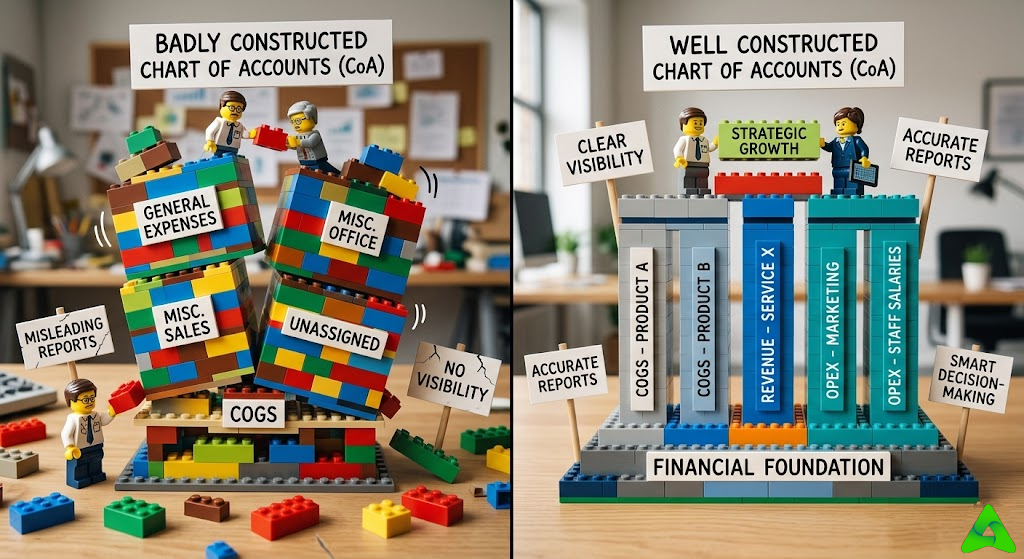
In the financial world, your Chart of Accounts (CoA) is that map database.
Too often, fast-growing companies treat the CoA as a mere compliance checklist, a back-office task to keep the tax authorities happy.
But at Adventus, we see it differently. Your Chart of Accounts isn’t just a ledger; it is the structural foundation of your entire business intelligence. Get it right, and you have a crystal-clear roadmap. Get it wrong, and you are flying blind.
Here is why a well-structured Chart of Accounts is critical to your business’s survival and growth.
1. A Badly Structured CoA Costs Vital Visibility
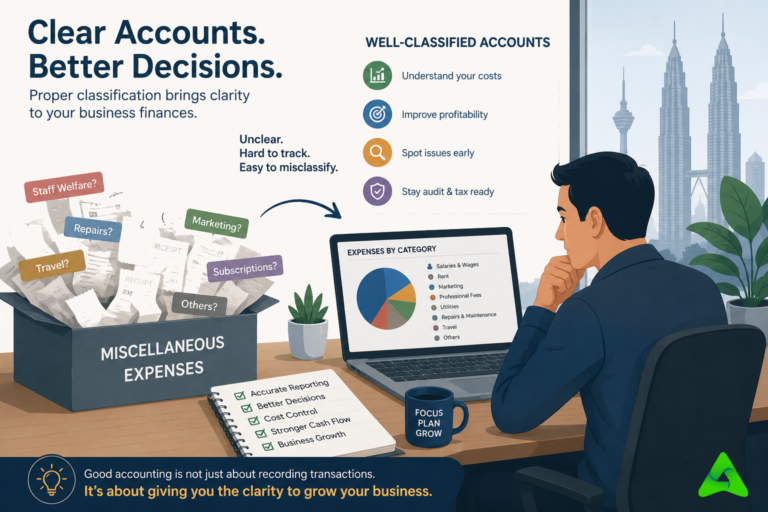
When a Chart of Accounts is built haphazardly, it creates immediate blind spots. The most common symptom? The dreaded “Everything Drawer” effect.
When accounts are too broad or poorly defined, teams end up dumping vastly different expenses into massive catch-all buckets like “General Expenses” or “Miscellaneous Operations.”
- The Cost: You lose the ability to see exactly where your cash is bleeding or which product lines are actually driving margin.
- The Reality: Without granular, logical categorization, you cannot perform accurate variance analysis. You might see that your expenses went up by 20% this quarter, but a messy CoA will force your finance team to spend days digging through individual receipts just to find out why.
2. Accurate Numbers, Misleading Reports
There is a dangerous misconception in business: “As long as the data entry is accurate and the bank reconciles, our financial statements are correct.” Unfortunately, accuracy does not equal clarity. You can have flawless, penny-perfect data entry, but if the CoA architecture is flawed, your financial reports will be fundamentally misleading.
For example, imagine you run a trading shop selling imported snacks. If you accidentally mix the shipping and import costs of bringing those snacks into Malaysia (Cost of Goods Sold) with the petrol and parking you paid to run normal office errands (Operating Expenses), your profit margins will look completely wrong.
On paper, it might look like you are making a huge profit on every packet of snacks sold. But in reality, once you factor in those hidden shipping costs, your actual product margin is tiny, meaning the stock is eating up your cash without you even realizing it.
3. The Real Challenge: The Reporting Structure
At its core, the ultimate purpose of accounting isn’t just tracking money, it’s facilitating decision-making. This is where the real challenge of the CoA lies: it dictates your reporting structure.
The Numbers Game: Your numbers may be 100% accurate, but if they are grouped incorrectly, executive decision-making becomes an uphill battle.
Consider a business trying to decide whether to scale up its marketing efforts or hire more sales reps.
- If “Marketing Spend,” “Sales Travel,” and “Client Entertainment” are all lumped together under a single “Sales & Marketing” line item, leadership cannot evaluate the ROI of specific initiatives.
- They can’t see if a drop in revenue is due to an inefficient sales team or an underfunded marketing funnel.
A sophisticated reporting structure, built on a well-designed CoA, groups accounts by responsibility, department, or revenue stream. It allows leaders to look at a Profit & Loss statement and instantly see the story behind the numbers, rather than a confusing wall of text.
Building for the Future
A great Chart of Accounts strikes a perfect balance: it is detailed enough to provide actionable insights, yet simple enough that your team can code expenses accurately without getting decision fatigue.
As your business grows, scales, and introduces new complexities, your CoA must be ready to support that weight. If you haven’t reviewed your financial architecture lately, it’s time to look under the hood.
Is your Chart of Accounts driving your business forward, or is it clouding your vision?
Don’t let a messy Chart of Accounts cloud your business growth.
At Adventus, we help Malaysian SMEs restructure their accounts so you can see your true profits and make smarter decisions. Book a complimentary 30-minute consultation with our team today, and let’s get your financial foundation right.