Why Monthly Closing Matters for Every Business
For many SMEs, monthly closing can feel like an administrative chore.
But in reality, it’s one of the most powerful financial disciplines a business can adopt.
A timely and accurate monthly close provides visibility, strengthens decision‑making, and helps business owners stay in control of growth, cash flow, and risks.
In this article, we’ll cover:
- Why monthly closing is essential
- Step‑by‑step monthly closing process
- Key reports owners should review
- What to monitor and red flags to look out for
Why Monthly Closing Matters
1. Ensures Accurate Financial Information
A proper month-end close ensures all income, expenses, and adjustments are recorded correctly.
Without it, financial data becomes unreliable, which leads to poor decisions and potential cash flow issues.
2. Improves Cash Flow Management
Closing the books monthly helps you spot:
- Late-paying customers
- Excessive supplier payments
- Cash gaps before they become problems
This allows better planning and timely corrective actions.
3. Prevents Accumulated Errors
Small mistakes in bookkeeping can snowball.
Monthly closing catches:
- Duplicate entries
- Missing invoices
- Incorrect allocations
- Unreconciled transactions
Fixing issues monthly is far easier than discovering them after months of backlog.
4. Supports Compliance and Audit Readiness
A structured monthly close ensures:
- Proper documentation
- Accurate tax filings
- Smooth audit processes
It saves time, money, and unnecessary stress.
5. Empowers Management Decisions
Owners get a clear view of:
- Profit performance
- Cash position
- Operating costs
- Budget vs. actual
This allows strategic decisions based on facts, not assumptions.
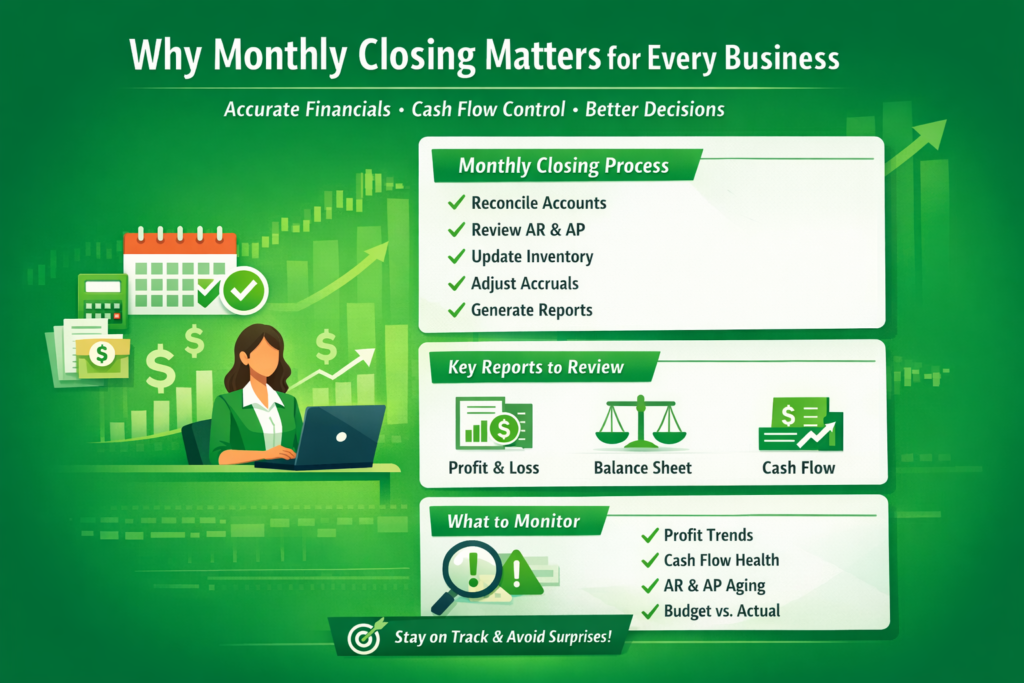
Step-by-Step Monthly Closing Process
Here’s a simple, SME-friendly workflow:
1. Reconcile All Bank & Payment Accounts
Include:
- Bank accounts
- Credit cards
- eWallets (Grab, TnG, etc.)
- Payment gateways (Stripe, PayPal)
Ensure all transactions are matched to accounting records.
2. Verify Customer Invoices (Accounts Receivable)
- Confirm all sales for the month are invoiced
- Match payments to invoices
- Identify overdue accounts
- Update aging schedule
3. Review Supplier Bills (Accounts Payable)
- Ensure all supplier invoices are recorded
- Check pending bills
- Match payments to bills
- Review recurring expenses (subscriptions, utilities, retainers)
4. Update Inventory and Cost of Goods Sold
- Inventory count or system update
- Adjust COGS
- Review product margins
5. Record Accruals and Prepayments
Examples:
- Staff salaries earned but not yet paid
- Prepaid insurance
- Expenses covering multiple months
Ensures expenses match the correct period.
6. Review Fixed Assets & Depreciation
- Add newly purchased assets
- Update depreciation for the month
7. Post Journal Adjustments
Accountant-led corrections for:
- Mispostings
- Accruals
- Deferred revenue
- Forex adjustments (if applicable)
8. Review Trial Balance
Ensure balances look correct and consistent.
9. Generate Financial Statements
- Profit & Loss
- Balance Sheet
- Cash Flow Statement
These form the basis for monthly review.
Key Reports Owners and Management Should Review
1. Profit & Loss (Income Statement)
What to look out for:
- Revenue growth or decline
- Gross profit margin
- Operating expenses creeping up
- Profitability by product/service
- Comparison to previous months or budget
Red flags:
- Sales increasing but profit shrinking
- Unexpected spikes in expenses
- Declining margins
2. Balance Sheet
What to monitor:
- Cash balances
- Accounts receivable aging
- Accounts payable aging
- Inventory levels
- Loan balances
Red flags:
- High receivables ageing (customers not paying)
- High payable ageing (risk of supplier issues)
- Negative retained earnings
- Low cash relative to liabilities
3. Cash Flow Statement
(or at minimum, a cash movement summary)
What to check:
- Cash inflow vs. outflow
- Operating cash flow health
- Large unexpected movements
Red flags:
- Profitable but negative cash flow
- Heavy reliance on external funding to operate
4. AR & AP Aging Schedules
AR aging: Spot slow-paying customers
AP aging: Prevent supplier disruption
5. Budget vs. Actual Report
What to check:
- Variances in income
- Variances in expenses
- Whether the business is on track with goals
Conclusion
Monthly closing is not just an accounting task, it’s a business discipline that gives owners control, clarity, and confidence.
With consistent monthly closing, SMEs can:
Want clearer, more reliable financials every month?
Let’s talk about how a proper monthly closing process can strengthen your business.