What Really Drives Business Progress? It’s Simpler Than You Think
In an increasingly complex business landscape, it’s easy to assume that progress comes from adding more, more systems, more data, more layers of analysis.
But forward movement doesn’t come from complexity. It comes from clarity.
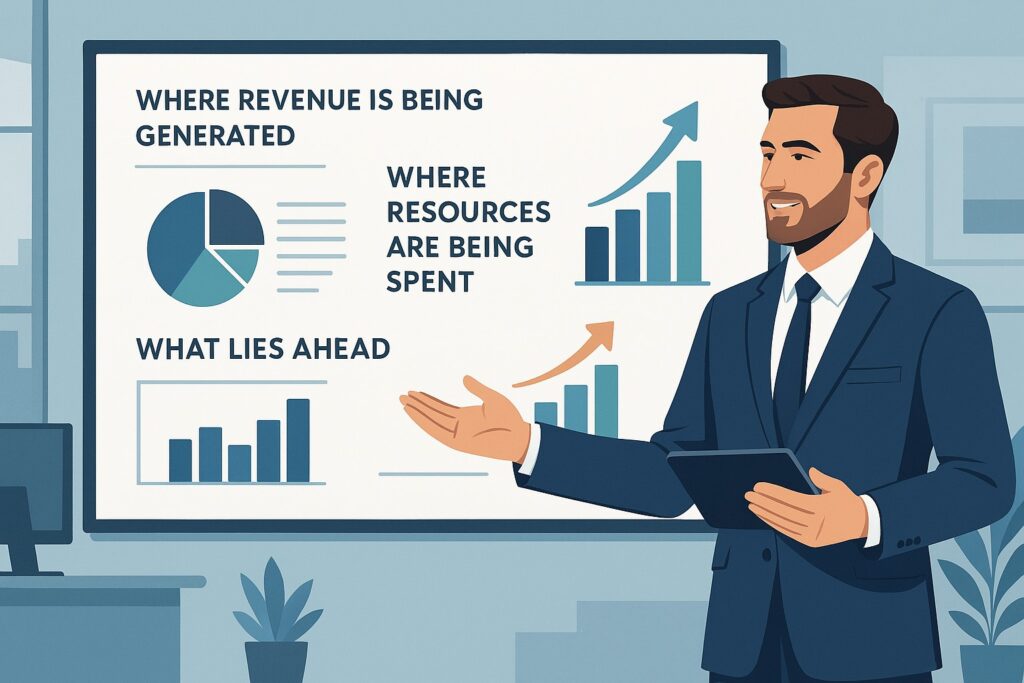
At its foundation, every high-performing business stays grounded in three essential truths:
- Where revenue is being generated
- Where resources are being spent
- What lies ahead based on current signals
When these are clearly understood, businesses stop reacting to problems and start getting ahead of them.
1. Knowing Where Revenue is Being Generated
It’s not enough to know how much money your business is making, you need to understand where it’s coming from and how reliable it is.
Too often, revenue is reviewed only after the fact. But the real advantage comes from visibility in the present.
Businesses that stay ahead consistently ask:
- Which clients, products, or channels are driving income?
- How stable or predictable are these streams?
- Where are the early signs of growth or decline?
With this level of awareness, organisations can:
- Strengthen the areas that are performing well
- Address risks before they impact cash flow
- Plan future growth with greater confidence
Revenue becomes more than a report, it becomes a guide.
2. Understanding Where Resources Are Being Spent
On the other side of the equation is cost. And while every business tracks expenses, not every business truly understands them.
Clarity around spending isn’t just about control, it’s about intention.
- Are expenditures aligned with business priorities?
- Which costs contribute to growth, and which don’t?
- Where are inefficiencies quietly building up?
When businesses gain a clearer picture of their outflows, they can:
- Improve profitability without drastic cuts
- Redirect investment toward what matters most
- Operate with greater discipline and agility
It shifts the conversation from “how much did we spend?” to “was it worth it?”
3. Seeing What Lies Ahead
Perhaps the greatest differentiator between businesses that survive and those that scale is their ability to anticipate what’s next.
Most organisations rely heavily on hindsight, looking at past performance to guide future decisions. But in a fast-changing environment, that’s often not enough.
The real advantage comes from foresight.
- What trends are emerging beneath the surface?
- Where might pressures or shortfalls appear?
- What opportunities are beginning to take shape?
With forward visibility, businesses can:
- Prepare for challenges before they escalate
- Adapt quickly to changing conditions
- Make confident decisions instead of cautious guesses
It’s the difference between reacting to change and leading through it.
From Uncertainty to Confidence
When these three elements come together, clear insight into income sources, a strong grasp of spending, and the ability to anticipate what’s next, businesses gain something invaluable: confidence.
Not just confidence in their numbers, but in their decisions.
- They act earlier
- They move faster
- They operate with purpose
And most importantly, they avoid being caught off guard.
Why This Matters Now
In today’s environment, where margins are tighter and competition is stronger, delayed action can be costly. A lack of clarity doesn’t just slow businesses down, it exposes them to unnecessary risk.
What organisations need isn’t more information. They need better visibility.
They need a clear, connected view of how money flows through their business, and where it’s heading next.
Clarity Is Your Competitive Advantage in a Volatile World
In today’s volatile global environment, this clarity has never been more critical.
Ongoing tensions and instability in the Middle East are a strong reminder of how quickly external factors, such as supply chain disruptions, fluctuating energy costs, and shifting investor confidence, can impact businesses far beyond the region.
For organisations everywhere, the ability to clearly understand where revenue is generated, how costs are evolving, and what potential disruptions lie ahead is no longer a competitive advantage, it’s a necessity. Businesses that maintain this level of visibility are far better positioned to adapt, protect margins, and make informed decisions even in uncertain times.
Points to ponder
Growth doesn’t come from guessing. It comes from clarity.
- Where is your money being made?
- Where is it being used?
- What does the road ahead look like?
Answer these well, and everything else becomes easier to navigate.
The Adventus Approach
At Adventus, we believe that better decisions come from better visibility.
Our focus is on helping businesses:
- Clearly track and understand their sources of income
- Gain meaningful insight into how and where money is being spent
- Build a forward-looking view that supports proactive planning
Because when you can clearly see both what’s happening now and what’s coming next, you’re no longer just managing your business, you’re actively moving it forward.