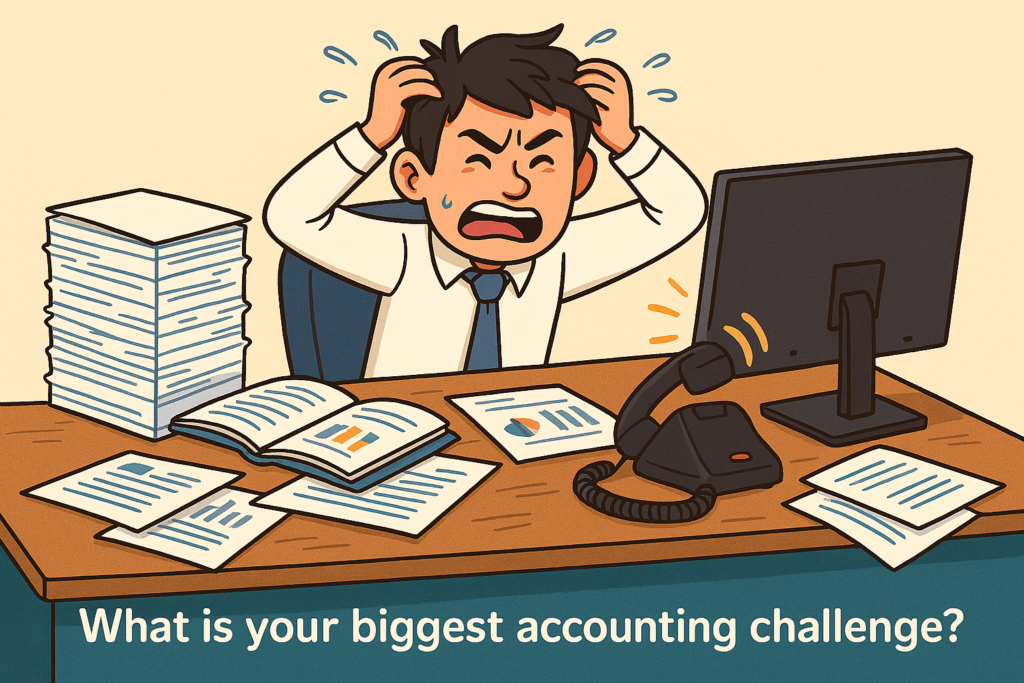
What Is Your Biggest Accounting Challenge?
When business owners are asked this question, the answer is often immediate: “Accounting is complicated.”
But is it really?
In reality, accounting need not be a challenge at all, when it is structured properly.
Accounting is a systematic discipline, governed by established principles and rules. When those fundamentals are respected, most problems are preventable.
So why do so many organisations still struggle?
Accounting Is Systematic by Design
At its core, accounting follows a logical framework:
- Every transaction has one or more debits and credits
- Income and expenses are clearly categorised
- Assets, liabilities, and equity follow defined classifications
- Transactions are recorded within fixed accounting periods
These principles are not optional or subjective. They provide structure, consistency, and traceability.
When accounting adheres to this system, financial information becomes reliable and meaningful.
Accounting itself is rarely the issue, it is how it is implemented.
Reporting Can Be Standardised to Support Management
Monthly and yearly reporting does not need to be reinvented each time. In fact, effective reporting is almost always standardised:
- Monthly management accounts for performance tracking
- Budget vs actual reporting for control
- Cash flow reporting for liquidity management
- Year‑end financial statements for compliance and tax purposes
Once reporting formats and timelines are defined, the process becomes repeatable and efficient. Rather than creating stress, accounting reports become tools management can rely on for decision‑making.
If You’re Struggling, Look at the Root Causes
When accounting does feel difficult, the reasons are often structural rather than technical.
1. Using the Wrong Accounting Solution
One of the most common issues is adopting systems that do not support the business’s actual requirements and processes.
Typical symptoms include:
- Software that cannot handle transaction volume or complexity
- Limited flexibility in reporting
- Poor alignment with operational workflows
- Weak integration with sales, inventory, or payroll
When systems do not fit the business, teams compensate with manual workarounds, spreadsheets, and inconsistent practices—introducing risk and inefficiency.
2. No Standard Operating Procedures (SOPs)
Another critical gap is the absence of defined SOPs.
Without SOPs:
- Transactions are recorded inconsistently
- Closing timelines slip every month
- Internal controls are weak or undocumented
- Knowledge sits with individuals instead of the organisation
Accounting should be process‑driven, not person‑dependent. SOPs create consistency, accountability, and continuity, even when staff changes.
The Role of a Reliable Advisor
This is where a reliable accounting advisor plays an important role.
A good advisor does not start by recommending software or imposing templates. Instead, they begin by:
- Understanding the business model and operations
- Identifying management’s reporting and decision‑making needs
- Assessing existing processes and pain points
- Designing an accounting structure that supports those needs
By aligning systems, processes, and reporting with the realities of the business, an advisor helps ensure accounting works for the business, not against it. The right structure reduces friction, improves visibility, and allows management to focus on running and growing the organisation.
Other Factors That Often Go Unnoticed
Several additional factors can undermine otherwise sound accounting setups:
- Limited financial literacy at management level, leading to under‑utilisation of accounting information
- Poor source documentation and data discipline, resulting in unreliable numbers
- Over‑customisation, which complicates processes without adding value
- Growth without process redesign, where systems that once worked no longer scale
Each of these issues reinforces the same point: accounting problems are rarely caused by accounting rules themselves.
A Better Question to Ask
Instead of asking, “What is my biggest accounting challenge?”
Consider asking:
“Is my accounting structure aligned with my business needs, systems, and decision‑making processes?”
When fundamentals are right, systems are fit for purpose, and processes are properly designed, with the guidance of a trusted advisor, accounting becomes predictable, reliable, and valuable.
And that is exactly what it should be.
How Adventus Can Help
This is where Adventus comes in.
With over 27 years of hands‑on, practical accounting experience, Adventus understands that effective accounting is not about theory alone, it is about execution.
Beyond core accounting expertise, Adventus has extensive experience in the implementation of accounting solutions across multiple industries, helping businesses translate accounting principles into systems and processes that actually work.
Adventus works with organisations to:
- Understand business operations and management requirements
- Design accounting structures that align with how businesses function
- Select and implement accounting solutions that support growth
- Standardise reporting and SOPs for clarity and control
Whether you are facing growing pains, inefficient systems, or unclear financial reporting, the right structure, designed upfront, makes all the difference.
If you believe your accounting should work for your business, not against it, talk to us about building an accounting foundation that supports better decisions, stronger controls, and sustainable growth.